Share this post
600 km range for the Renault Trucks E-Tech T, from 2025

600 km range for the Renault Trucks E-Tech T, from 2025

Published on 25 Nov 2024 • 3 min read

From 2025, Renault Trucks will be taking orders for an extension of its Renault Trucks E-Tech T model

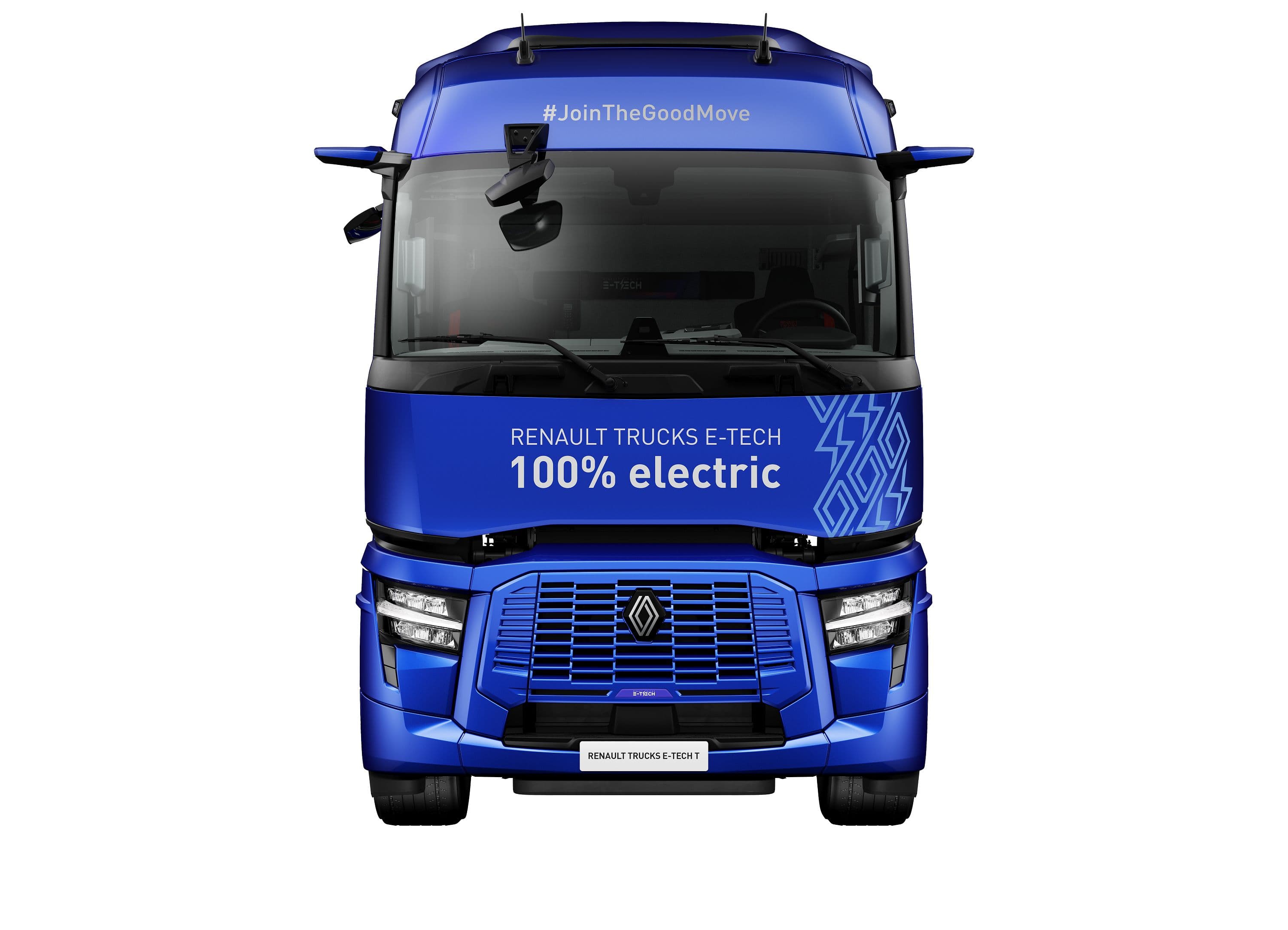
From 2025, Renault Trucks will be taking orders for an extension of its Renault Trucks E-Tech T model. With a range of 600 km on a single charge, this vehicle opens up new opportunities for the decarbonisation of long-haul transport.

With 30 million kilometres of proven performance in real world operation with customers, Renault Trucks electric trucks have already saved 29,000 tonnes of CO₂ emissions. With this new offer, the French manufacturer is further extending its range of sustainable transport solutions to support its customers in their energy transition.

  • Innovative technology driving performance

The increased range of the Renault Trucks E-Tech T is achieved by integrating a new component, namely an electric axle.

E-axle technology enables all the elements of the powertrain – electric motors and transmission – to be grouped together at the rear of the vehicle, freeing up space between the side members to accommodate additional battery packs. Renault Trucks E-Tech T equipped with e-axle can cover 600 km on a single charge.

Renault Trucks e-axle

“The advent of this electric truck will boost the transition to electric mobility”, explained Emmanuel Duperray, Senior Vice President Electromobility at Renault Trucks. “We believe that a range of 600 km on a single charge, combined with the development of public charging infrastructure networks by 2026 – in particular through our joint venture Milence – will enable us to achieve the operational parity [with diesel technology] that our customers expect.”

An offer that complements the existing range

Designed for long-haul transport, this Renault Trucks E-Tech T with an extended range will enhance the manufacturer's electric offering without replacing current solutions. Renault Trucks will indeed continue to offer a wide range of autonomies, configurations and equipment tailored to specific uses. In order to help hauliers find the ideal solution, Renault Trucks is also providing them with advanced simulation tools enabling each electric truck to be configured according to their specific needs.

“We're not looking to enter a race for autonomy on a single charge”, stressed Emmanuel Duperray. Oversized batteries penalise the payload, raise total operating costs and increase the environmental footprint. In essence, an electric truck is more expensive than a combustion vehicle. We need to rethink low-carbon logistics, in other words, reconsider transport patterns to optimise the use of transport vehicles and therefore reduce the cost per kilometre.”

Renault Trucks encourages its customers to adjust the size of the batteries according to their actual needs and provides support in optimising the solution, including the charging strategy. “This approach is already enabling us to achieve daily mileage of over 700 kilometres with our series production Renault Trucks E Tech T.”

Orders for this new vehicle will open in 2025, with production handled by the Bourg-en-Bresse plant, which has been assembling the brand's high-end electric ranges since the end of 2023.
More news

Farizon seals crystal clear van fleet win from Solar Windows
23 September 2026

Farizon seals crystal clear van fleet win from Solar Windows

Solar Windows has taken delivery of 20 new Farizon SV large vans to replace its diesel fleet across three UK sites.

Welch's Transport powers up Cambridge site with new megawatt eHGV charging hub
23 September 2026

Welch's Transport powers up Cambridge site with new megawatt eHGV charging hub

Welch's Transport has opened a new megawatt-scale eHGV charging hub at its Cambridge headquarters through eFREIGHT 2030.

Renault Trucks steps up its ambitions in the LCV market and presents the new Renault Trucks E-Tech Trafic
22 September 2026

Renault Trucks steps up its ambitions in the LCV market and presents the new Renault Trucks E-Tech Trafic

At the 2026 IAA show in Hanover, Renault Trucks presented for the first time its new light commercial vehicle developed on a 100% electric platform: the Renault Trucks E-Tech Trafic.

Chery UK to launch four new and updated models in the next 12 months to drive strategic growth
12 September 2026

Chery UK to launch four new and updated models in the next 12 months to drive strategic growth

Chery UK will launch four new and refreshed models over the next 12 months, including its first electric vehicle, as it builds on a strong first year in the UK market.

IVECO and Toyota join forces to advance next-generation hydrogen fuel cell heavy-duty trucks through the EU-funded EMPOWER project
10 September 2026

IVECO and Toyota join forces to advance next-generation hydrogen fuel cell heavy-duty trucks through the EU-funded EMPOWER project

IVECO and Toyota partner under the EU-funded EMPOWER project to develop next-generation hydrogen fuel cell heavy-duty trucks, targeting more than 900 km of range and 25,000 operating hours.

Under £20k: Harris MAXUS UK takes on compact electric van market with eDELIVER 3
7 September 2026

Under £20k: Harris MAXUS UK takes on compact electric van market with eDELIVER 3

Harris MAXUS UK launches a new sub-£20,000 acquisition proposition for its compact electric eDELIVER 3 van.

SINOTRUK targets UK zero-emission truck market with Harris Group deal
4 September 2026

SINOTRUK targets UK zero-emission truck market with Harris Group deal

Harris Group has signed a long-term deal to become SINOTRUK's exclusive UK and Ireland distributor, bringing a new range of battery-electric trucks to market from 2027.

Finding the Right Route to Zero: Matching Electric Trucks to Real-World Operations
1 September 2026

Finding the Right Route to Zero: Matching Electric Trucks to Real-World Operations

Mercedes-Benz Trucks' eActros 400 and eActros 600 share a common electric architecture but target very different duty cycles — showing there is no single route to net zero for fleet operators.