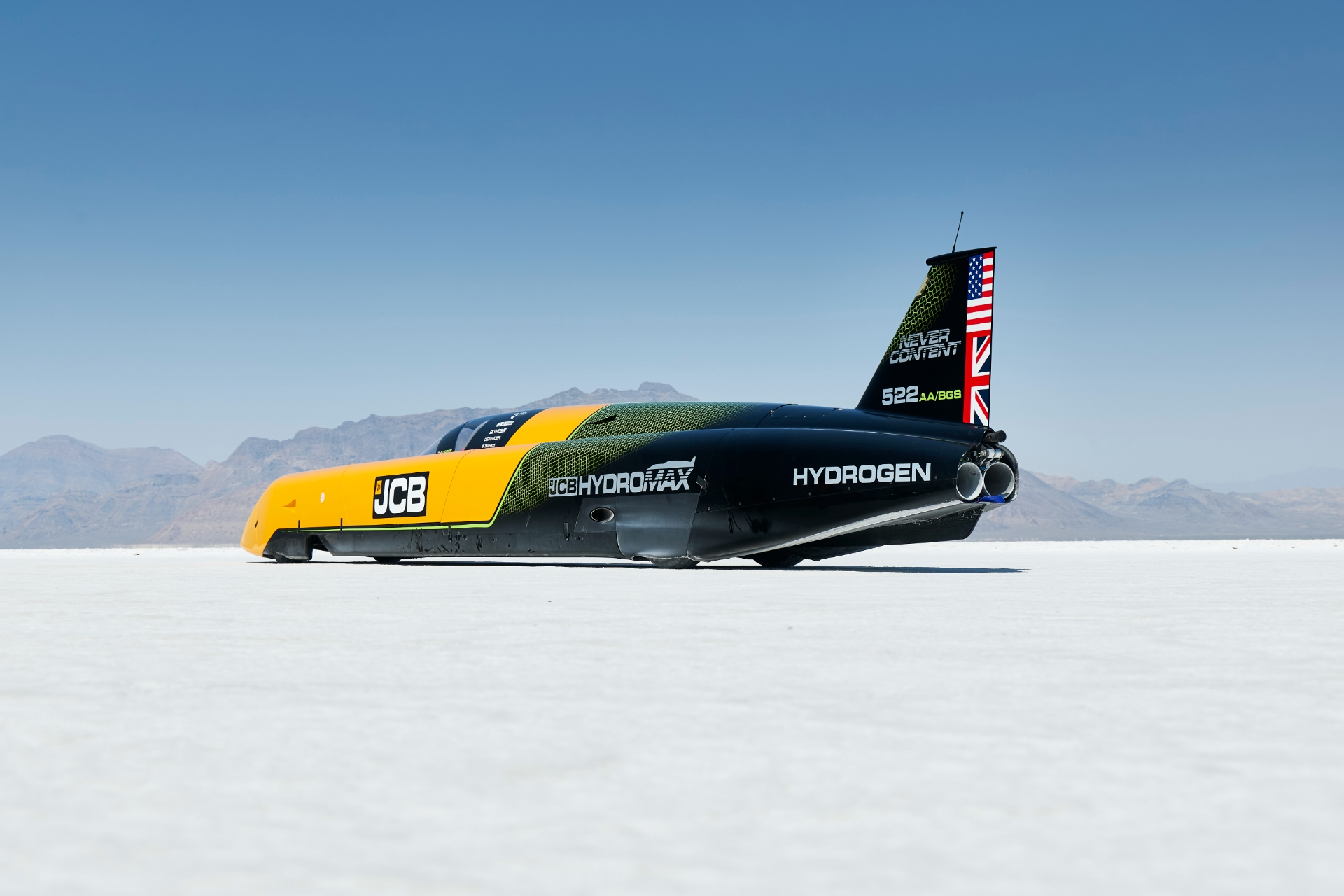
JCB’s Hydromax breaks the land speed record to become the world’s fastest vehicle powered by a hydrogen combustion engine.
JCB usually exists in the plant world where its machines are a common feature on construction sites, in quarries and on farms. But the company’s chairman, Lord Bamford, is never content with colouring inside the lines. Both from a technical standpoint and an exercise in imagination, Lord Bamford pushes JCB to go beyond what is expected.
“As a young boy in the 1950s, I remember reading The Eagle and Boys’ Own and being inspired by the daring deeds of the great world-record breakers. People such as Sir Malcolm Campbell and Donald Campbell, Sir Henry Segrave, George Eyston and, of course, Sir Stirling Moss. These were people who pushed machines – and themselves – beyond what everybody thought possible. They captured the imagination of a generation.”
This inspiration has been a guiding force for JCB in its pursuit of numerous world records over the years. Firstly, in 2006, the company built Dieselmax, the world’s fastest diesel-powered car which set a land speed record at 350.092mph. Eight years later, a V8 version of its iconic backhoe got up to 72.59mph to claim its position as the world’s fastest digger. Another world record was set in 2019 when Guy Martin drove the JCB Fastrac Two tractor to a peak speed of 153.771mph.
Advertisement
Pushing boundaries
In February last year, Lord Bamford decided it was time to work towards another ambitious feat. Exactly 20 years after Dieselmax broke the diesel land speed record on the Bonneville Salt Flats in Utah, he tasked his team to return to the salt with a streamliner powered by hydrogen combustion. JCB’s engineering team, supported by Ricardo, Xtrac and Prodrive, spent 18 months designing, testing and iterating Hydromax.
JCB’s Hydromax
Two hydrogen engines were laid down as close as possible to the outer edges of the vehicle. Extensive aerodynamic development allowed for a completely closed nose and aeronautical testing facilities were used to make sure the tyres could withstand speeds over 350mph. Every minute component and system was tested, independently assessed and tested again to ensure Hydromax was as safe as humanly possible.
To set an FIA world land speed record, the governing body of motorsport wants to see two runs in opposite directions and allows a pit stop in between of up to an hour. On each run, the vehicle’s speed is measured over a set mile – in this case from mile 5.5 to 6.5. The final record is set based on an average across both runs.
Very few humans have travelled on land at more than 350mph, so the faster you want to go, the smaller the pool of drivers is to choose from. But from the very start of the project, there was no question that former RAF Wing Commander, Andy Green OBE, would be the person in Hydromax’s cockpit.
Green holds the outright world land speed record at 763.035mph in Thrust SSC, during which he became the only person to break the sound barrier on land. He also has a long history with JCB, having driven Dieselmax to its record-breaking finish.
Record breaker
Out on the salt flats this August, a week after hitting 368.347mph to set a Southern California Timing Association class record, Hydromax lined up at the start of the 10-mile track. JCB hadn’t officially confirmed a target speed, but everyone was quietly speculating it would be in excess of 400mph.
On the first run, the FIA confirmed an average speed of 400.623mph. Green admitted he didn’t mean to cut it that close to 400mph, so on the second run, a result of 412.135mph took Hydromax comfortably above 400mph to set the hydrogen combustion engine world land speed record at 406.320mph.
Speaking after the record was confirmed, Lord Bamford thanked the entire Hydromax team and said: “Andy, you are a true British hero, and we are enormously proud to have you as part of this extraordinary story.”
Best of British
Lord Bamford
As much as Hydromax fulfilled personal achievements for all involved, it was an opportunity for JCB to showcase British engineering on a global stage and reassert its commitment to the hydrogen engine.
Lord Bamford concluded:
“The great record-breakers I read about as a boy inspired generations because they showed us there was always another frontier to cross. Today, JCB Hydromax has crossed another one. And I very much hope that somewhere there is a young boy or girl looking at what this team has achieved and thinking: ‘One day, I want to do something like that.’ Because that is how engineering moves forward. That is how records are broken. And that is how history is made.”
JCB usually exists in the plant world where its machines are a common feature on construction sites, in quarries and on farms. But the company’s chairman, Lord Bamford, is never content with colouring inside the lines. Both from a technical standpoint and an exercise in imagination, Lord Bamford pushes JCB to go beyond what is expected.
“As a young boy in the 1950s, I remember reading The Eagle and Boys’ Own and being inspired by the daring deeds of the great world-record breakers. People such as Sir Malcolm Campbell and Donald Campbell, Sir Henry Segrave, George Eyston and, of course, Sir Stirling Moss. These were people who pushed machines – and themselves – beyond what everybody thought possible. They captured the imagination of a generation.”
This inspiration has been a guiding force for JCB in its pursuit of numerous world records over the years. Firstly, in 2006, the company built Dieselmax, the world’s fastest diesel-powered car which set a land speed record at 350.092mph. Eight years later, a V8 version of its iconic backhoe got up to 72.59mph to claim its position as the world’s fastest digger. Another world record was set in 2019 when Guy Martin drove the JCB Fastrac Two tractor to a peak speed of 153.771mph.
Pushing boundaries
In February last year, Lord Bamford decided it was time to work towards another ambitious feat. Exactly 20 years after Dieselmax broke the diesel land speed record on the Bonneville Salt Flats in Utah, he tasked his team to return to the salt with a streamliner powered by hydrogen combustion. JCB’s engineering team, supported by Ricardo, Xtrac and Prodrive, spent 18 months designing, testing and iterating Hydromax.
JCB’s Hydromax
Two hydrogen engines were laid down as close as possible to the outer edges of the vehicle. Extensive aerodynamic development allowed for a completely closed nose and aeronautical testing facilities were used to make sure the tyres could withstand speeds over 350mph. Every minute component and system was tested, independently assessed and tested again to ensure Hydromax was as safe as humanly possible.
To set an FIA world land speed record, the governing body of motorsport wants to see two runs in opposite directions and allows a pit stop in between of up to an hour. On each run, the vehicle’s speed is measured over a set mile – in this case from mile 5.5 to 6.5. The final record is set based on an average across both runs.
Very few humans have travelled on land at more than 350mph, so the faster you want to go, the smaller the pool of drivers is to choose from. But from the very start of the project, there was no question that former RAF Wing Commander, Andy Green OBE, would be the person in Hydromax’s cockpit.
Green holds the outright world land speed record at 763.035mph in Thrust SSC, during which he became the only person to break the sound barrier on land. He also has a long history with JCB, having driven Dieselmax to its record-breaking finish.
Record breaker
Out on the salt flats this August, a week after hitting 368.347mph to set a Southern California Timing Association class record, Hydromax lined up at the start of the 10-mile track. JCB hadn’t officially confirmed a target speed, but everyone was quietly speculating it would be in excess of 400mph.
On the first run, the FIA confirmed an average speed of 400.623mph. Green admitted he didn’t mean to cut it that close to 400mph, so on the second run, a result of 412.135mph took Hydromax comfortably above 400mph to set the hydrogen combustion engine world land speed record at 406.320mph.
Speaking after the record was confirmed, Lord Bamford thanked the entire Hydromax team and said: “Andy, you are a true British hero, and we are enormously proud to have you as part of this extraordinary story.”
Best of British
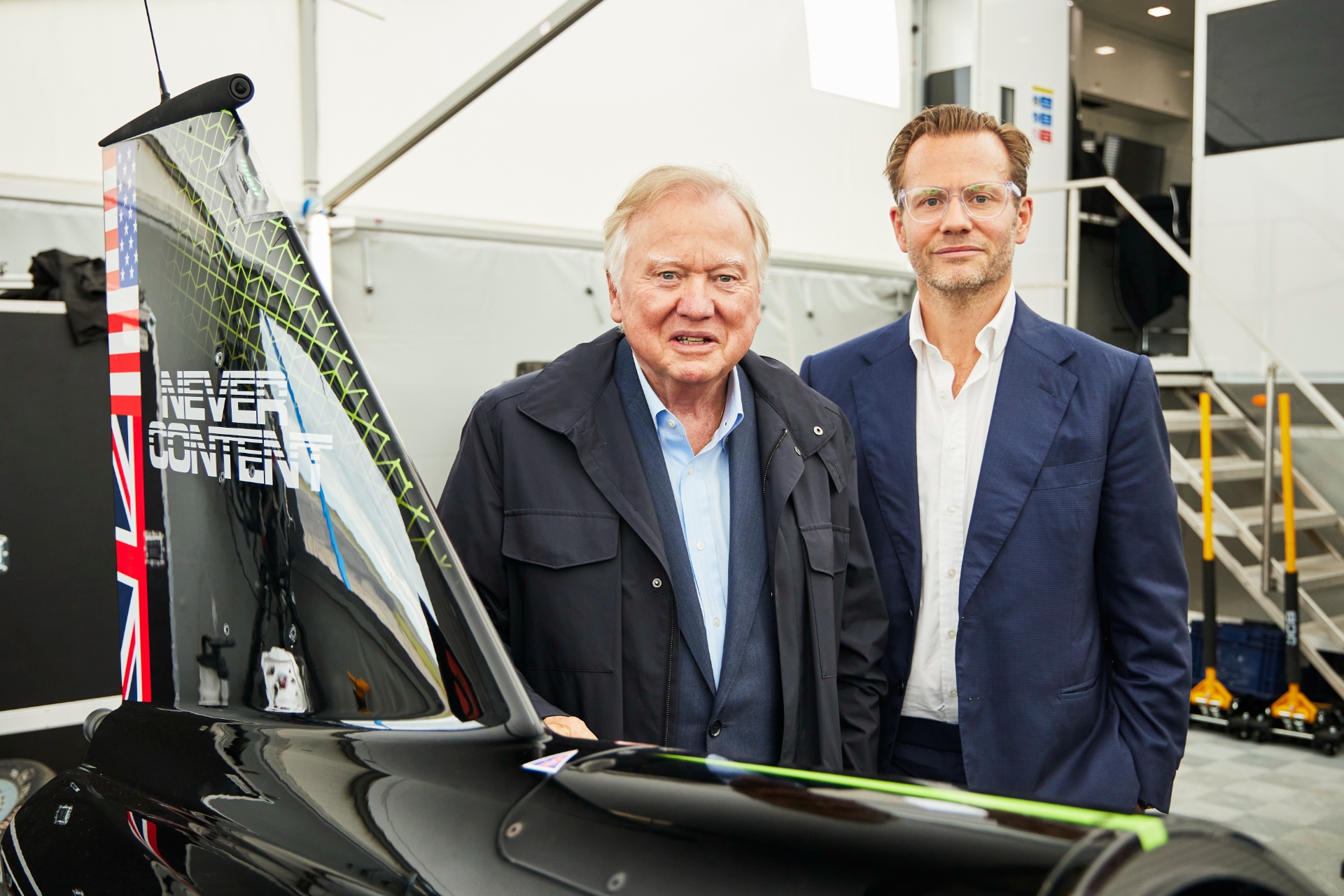
Lord Bamford with Andy Green OBE
As much as Hydromax fulfilled personal achievements for all involved, it was an opportunity for JCB to showcase British engineering on a global stage and reassert its commitment to the hydrogen engine.
Lord Bamford concluded:
“The great record-breakers I read about as a boy inspired generations because they showed us there was always another frontier to cross. Today, JCB Hydromax has crossed another one. And I very much hope that somewhere there is a young boy or girl looking at what this team has achieved and thinking: ‘One day, I want to do something like that.’ Because that is how engineering moves forward. That is how records are broken. And that is how history is made.”