Volvo reinvents the 13-Litre engine for the next era of trucking.
With IAA Transportation in Hanover fast approaching, manufacturers are preparing to unveil the technologies that will shape the next generation of commercial vehicles. Among the first to show its hand is Volvo Trucks, which has recently revealed a comprehensive overhaul of both its combustion engine range and its electric truck line-up.
The Swedish manufacturer’s latest developments make one thing abundantly clear: while electrification continues to advance, the internal combustion engine remains central to long-haul transport for many years to come. Rather than viewing diesel, gas, hydrogen and battery-electric as competing technologies, Volvo is investing across every powertrain, ensuring operators have the flexibility to choose the solution that best fits their operation.
At the heart of Volvo’s announcement is an all-new 13-litre engine platform, entering production in January 2027. Replacing the long-serving D13 and the outgoing 10.8-litre D11, the new engine family has been designed around a common architecture capable of supporting diesel today and hydrogen combustion in the future.
Advertisement
The timing is significant. Euro 7 emissions legislation begins arriving from 2028, while operators continue to demand lower fuel consumption and reduced CO2 emissions without compromising reliability or performance.
A new foundation
Volvo says the new D13 and G13 engines are its most fuel-efficient combustion engines to date, surpassing even the highly regarded D13 Turbo Compound engine introduced under the I-Save programme in 2019.
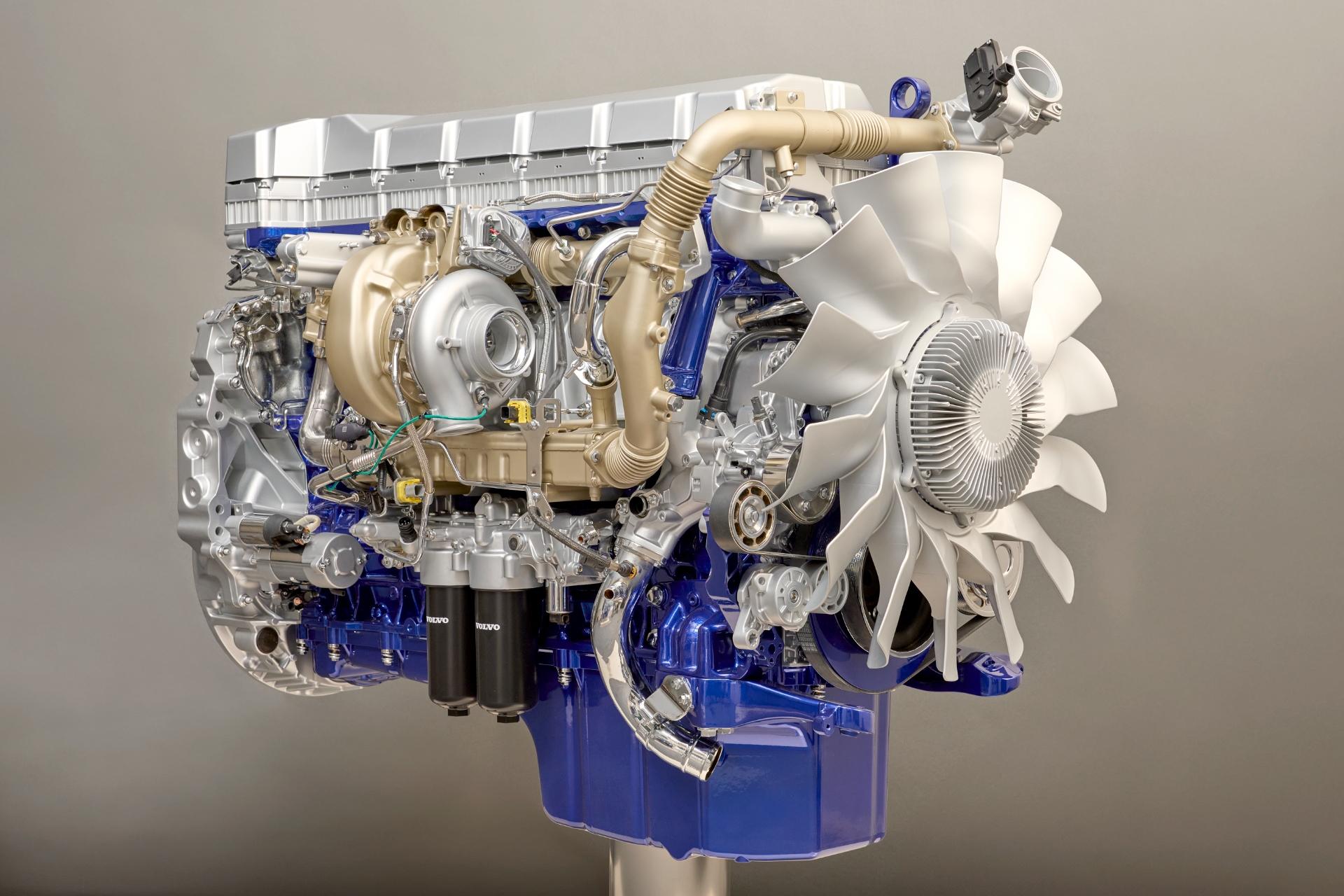
Volvo's all-new diesel engine
But rather than relying on one breakthrough, Volvo has achieved its claimed efficiency gains through a series of engineering refinements. A completely redesigned cast-iron cylinder block and cylinder head provide greater strength while reducing weight. The stronger construction allows higher combustion pressures and compression ratios, improving both thermal efficiency and overall performance.
Dual-wave innovation
The company’s patented wave piston technology has also evolved. Previously introduced with the turbo-compound engine, the latest design incorporates dual-wave piston bowls that improve combustion efficiency, delivering increased power and torque while reducing fuel consumption and emissions. The G13 gas engine also benefits from wave piston technology for the first time.
A new variable-geometry turbocharger replaces the previous design, offering improved efficiency across a wider operating range. Ball-bearing technology and revised turbine geometry allow the system to respond more effectively under varying loads, while also supporting a significantly more powerful engine brake.
Braking performance now reaches 470kW at 2300rpm – 40kW more than the previous turbo-compound engine and around 130kW higher than the earlier eSCR-powered D13.
Better fuel economy
Volvo quotes fuel savings of up to 4% compared with the previous non-turbo compound D13 engine. As always, those figures depend on specification and operating conditions. The comparison is based on a 500hp tractor operating at 35 tonnes GCW and making full use of Volvo’s predictive driving technologies, including I-See GPS cruise control and I-Roll Eco Roll.
The equivalent G13 gas engine is expected to deliver improvements in a similar range.
Power outputs now extend to a new flagship 560hp producing 2900Nm of torque, while 500hp, 460hp and 420hp variants continue. The FM range also gains a new 380hp option, replacing applications previously served by the D11.
Every diesel version is approved for HVO renewable diesel, while the 500hp and 460hp engines can also operate on B100 biodiesel, reflecting growing interest in renewable liquid fuels as operators seek practical carbon reduction strategies.
Gas options
Volvo continues to back LNG as a viable transition fuel, particularly where fleets require substantial carbon savings without moving immediately to battery-electric operation. Unlike Scania and Iveco, which use spark-ignition gas engines, Volvo’s G13 employs High Pressure Direct Injection (HPDI), using a small quantity of diesel as an ignition source while the engine itself operates much like a conventional diesel. The result is a driving experience that closely mirrors diesel performance, while maintaining the efficiency advantages of compression ignition.
Torque has increased by as much as 300Nm across the G13 range, while power outputs remain at 420hp, 460hp and 500hp.
Volvo also claims that when the engine operates on BioLNG with HVO as its ignition fuel, lifecycle CO2 emissions can be reduced by up to 100 per cent on a well-to-wheel basis.
Perhaps more importantly, the G13 architecture forms the basis of Volvo’s future hydrogen combustion engine programme. Prototype vehicles are already undergoing road testing, with commercial introduction planned before the end of the decade.
Smarter I-Shift
Supporting the new engines is an updated generation of Volvo’s I-Shift transmission. The gearbox has been strengthened to cope with the 560hp engine’s 2900Nm output, while delivering faster gear changes and improved efficiency. New features include an integrated gearbox oil level sensor displayed within the vehicle’s pre-trip checks, and a revised retarder optimised for faster rear-axle ratios.
Volvo has also refined its innovative I-Roll engine stop/start system. During Eco Roll operation, a newly introduced clutch disconnects the power steering pump when it is not required, reducing parasitic losses and extracting further efficiency gains.
Electric advances
Volvo’s battery-electric range has also received a substantial update. The FH Electric, FM Electric and FMX Electric now offer operating ranges of up to 470km while supporting 350kW charging, reducing charging times from 20 to 80 per cent to approximately 65 minutes. Regenerative braking efficiency has also improved by around 10%.
A significant addition is a new electric Power Take-Off system that allows body equipment to operate while the vehicle is moving. By splitting duties between the truck’s twin electric motors, applications such as tippers can discharge while travelling slowly, while an additional transmission-mounted PTO enables equipment such as concrete mixers to operate even during charging.
At the centre of the updated electric drivetrain sits a newly developed eight-speed gearbox designed specifically for battery-electric vehicles. Featuring powershift technology, it provides smooth acceleration and uninterrupted torque delivery while offering familiar Economy, Standard and Performance driving modes across five power ratings ranging from 300kW to 540kW.
The biggest headline, however, belongs to the new FH Aero Electric Extended Range. With a claimed range of up to 700km, it becomes Volvo’s longest-range battery-electric truck to date and comfortably exceeds the 600km benchmark many operators have viewed as the threshold for viable long-distance transport.
The truck supports both 700kW Megawatt Charging System (MCS) charging and conventional 350kW CCS charging. Using MCS, Volvo says charging from 20% to 80% takes around 50 minutes.
Enter the e-axle
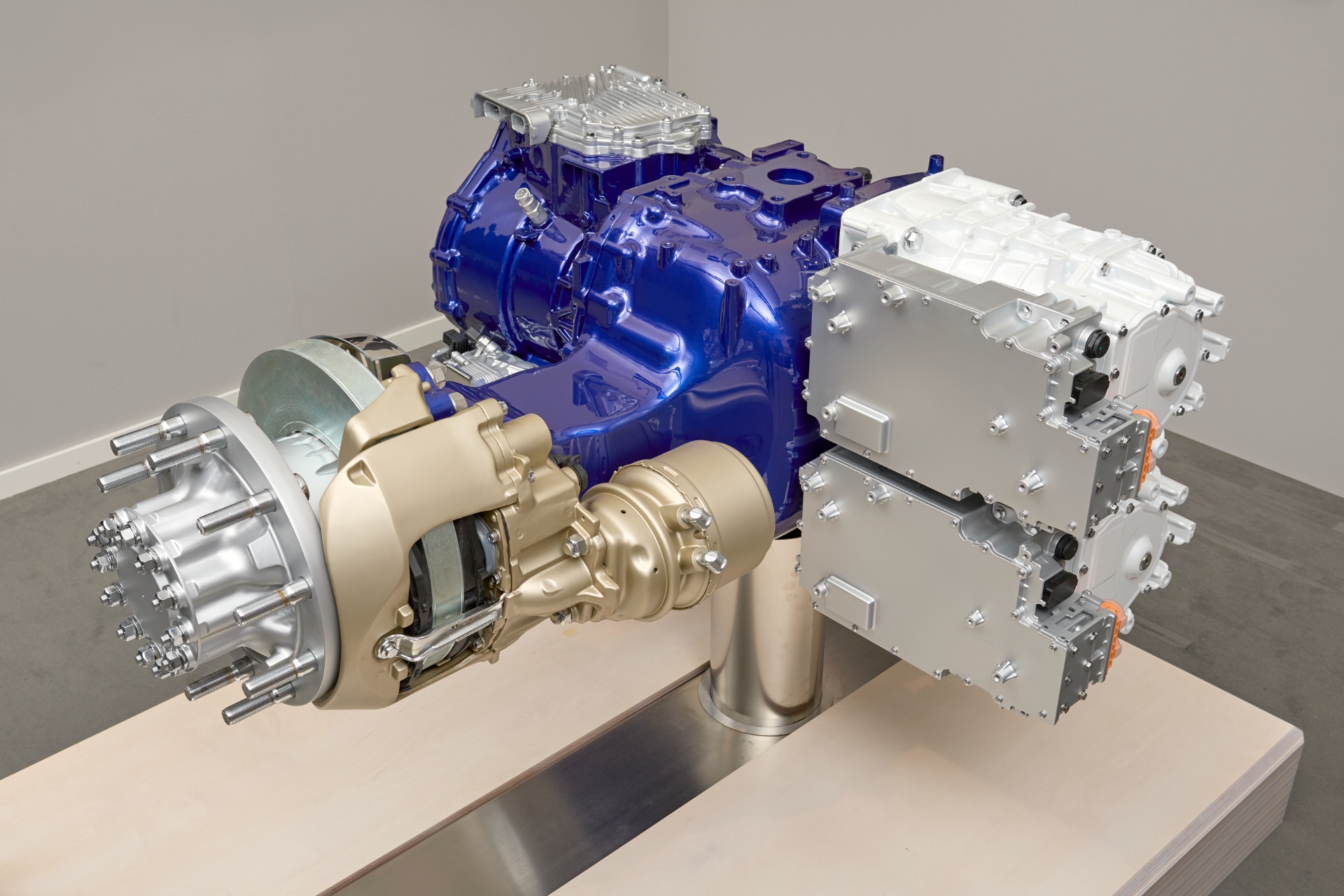
Volvo's E-Axle engine
Achieving that range required a significant redesign beneath the chassis. The FH Aero Extended Range is the first Volvo electric truck to adopt an e-axle. Rather than using a centrally mounted motor, the integrated drive axle combines twin electric motors with a six-speed transmission. More importantly, relocating the drivetrain frees valuable chassis space for additional batteries.
Volvo has taken advantage by introducing new L-shaped battery packs providing 725kWh of usable energy. Up to eight battery packs can be installed to achieve the headline 700km range.
The e-axle itself is available in 420kW and 460kW outputs and is fitted to a 6x2 tractor equipped with a 4.5-tonne tag axle. Besides maximising payload, the additional axle improves weight distribution, helping overcome overcome one of the key challenges facing high-capacity battery-electric tractors.
No single solution
Volvo’s latest product offensive demonstrates the future of heavy transport will not be defined by a single powertrain. Diesel continues to evolve. Gas offers an increasingly compelling route to rapid carbon reduction. Hydrogen combustion is moving steadily towards production. Battery-electric technology is extending its reach into ever longer-distance applications.
Rather than betting everything on one technology, Volvo Trucks is building a portfolio that allows operators to choose the right solution for each operation. As the industry heads towards IAA Transportation, that breadth of investment may prove to be one of the manufacturer’s greatest strengths.
With IAA Transportation in Hanover fast approaching, manufacturers are preparing to unveil the technologies that will shape the next generation of commercial vehicles. Among the first to show its hand is Volvo Trucks, which has recently revealed a comprehensive overhaul of both its combustion engine range and its electric truck line-up.
The Swedish manufacturer’s latest developments make one thing abundantly clear: while electrification continues to advance, the internal combustion engine remains central to long-haul transport for many years to come. Rather than viewing diesel, gas, hydrogen and battery-electric as competing technologies, Volvo is investing across every powertrain, ensuring operators have the flexibility to choose the solution that best fits their operation.
At the heart of Volvo’s announcement is an all-new 13-litre engine platform, entering production in January 2027. Replacing the long-serving D13 and the outgoing 10.8-litre D11, the new engine family has been designed around a common architecture capable of supporting diesel today and hydrogen combustion in the future.
The timing is significant. Euro 7 emissions legislation begins arriving from 2028, while operators continue to demand lower fuel consumption and reduced CO2 emissions without compromising reliability or performance.
A new foundation
Volvo says the new D13 and G13 engines are its most fuel-efficient combustion engines to date, surpassing even the highly regarded D13 Turbo Compound engine introduced under the I-Save programme in 2019.
Volvo's all-new diesel engine
But rather than relying on one breakthrough, Volvo has achieved its claimed efficiency gains through a series of engineering refinements. A completely redesigned cast-iron cylinder block and cylinder head provide greater strength while reducing weight. The stronger construction allows higher combustion pressures and compression ratios, improving both thermal efficiency and overall performance.
Dual-wave innovation
The company’s patented wave piston technology has also evolved. Previously introduced with the turbo-compound engine, the latest design incorporates dual-wave piston bowls that improve combustion efficiency, delivering increased power and torque while reducing fuel consumption and emissions. The G13 gas engine also benefits from wave piston technology for the first time.
A new variable-geometry turbocharger replaces the previous design, offering improved efficiency across a wider operating range. Ball-bearing technology and revised turbine geometry allow the system to respond more effectively under varying loads, while also supporting a significantly more powerful engine brake.
Braking performance now reaches 470kW at 2300rpm – 40kW more than the previous turbo-compound engine and around 130kW higher than the earlier eSCR-powered D13.
Better fuel economy
Volvo quotes fuel savings of up to 4% compared with the previous non-turbo compound D13 engine. As always, those figures depend on specification and operating conditions. The comparison is based on a 500hp tractor operating at 35 tonnes GCW and making full use of Volvo’s predictive driving technologies, including I-See GPS cruise control and I-Roll Eco Roll.
The equivalent G13 gas engine is expected to deliver improvements in a similar range.
Power outputs now extend to a new flagship 560hp producing 2900Nm of torque, while 500hp, 460hp and 420hp variants continue. The FM range also gains a new 380hp option, replacing applications previously served by the D11.
Every diesel version is approved for HVO renewable diesel, while the 500hp and 460hp engines can also operate on B100 biodiesel, reflecting growing interest in renewable liquid fuels as operators seek practical carbon reduction strategies.
Gas options
Volvo continues to back LNG as a viable transition fuel, particularly where fleets require substantial carbon savings without moving immediately to battery-electric operation. Unlike Scania and Iveco, which use spark-ignition gas engines, Volvo’s G13 employs High Pressure Direct Injection (HPDI), using a small quantity of diesel as an ignition source while the engine itself operates much like a conventional diesel. The result is a driving experience that closely mirrors diesel performance, while maintaining the efficiency advantages of compression ignition.
Torque has increased by as much as 300Nm across the G13 range, while power outputs remain at 420hp, 460hp and 500hp.
Volvo also claims that when the engine operates on BioLNG with HVO as its ignition fuel, lifecycle CO2 emissions can be reduced by up to 100 per cent on a well-to-wheel basis.
Perhaps more importantly, the G13 architecture forms the basis of Volvo’s future hydrogen combustion engine programme. Prototype vehicles are already undergoing road testing, with commercial introduction planned before the end of the decade.
Smarter I-Shift
Supporting the new engines is an updated generation of Volvo’s I-Shift transmission. The gearbox has been strengthened to cope with the 560hp engine’s 2900Nm output, while delivering faster gear changes and improved efficiency. New features include an integrated gearbox oil level sensor displayed within the vehicle’s pre-trip checks, and a revised retarder optimised for faster rear-axle ratios.
Volvo has also refined its innovative I-Roll engine stop/start system. During Eco Roll operation, a newly introduced clutch disconnects the power steering pump when it is not required, reducing parasitic losses and extracting further efficiency gains.
Electric advances
Volvo’s battery-electric range has also received a substantial update. The FH Electric, FM Electric and FMX Electric now offer operating ranges of up to 470km while supporting 350kW charging, reducing charging times from 20 to 80 per cent to approximately 65 minutes. Regenerative braking efficiency has also improved by around 10%.
A significant addition is a new electric Power Take-Off system that allows body equipment to operate while the vehicle is moving. By splitting duties between the truck’s twin electric motors, applications such as tippers can discharge while travelling slowly, while an additional transmission-mounted PTO enables equipment such as concrete mixers to operate even during charging.
At the centre of the updated electric drivetrain sits a newly developed eight-speed gearbox designed specifically for battery-electric vehicles. Featuring powershift technology, it provides smooth acceleration and uninterrupted torque delivery while offering familiar Economy, Standard and Performance driving modes across five power ratings ranging from 300kW to 540kW.
The biggest headline, however, belongs to the new FH Aero Electric Extended Range. With a claimed range of up to 700km, it becomes Volvo’s longest-range battery-electric truck to date and comfortably exceeds the 600km benchmark many operators have viewed as the threshold for viable long-distance transport.
The truck supports both 700kW Megawatt Charging System (MCS) charging and conventional 350kW CCS charging. Using MCS, Volvo says charging from 20% to 80% takes around 50 minutes.
Enter the e-axle
Volvo's E-Axle
Achieving that range required a significant redesign beneath the chassis. The FH Aero Extended Range is the first Volvo electric truck to adopt an e-axle. Rather than using a centrally mounted motor, the integrated drive axle combines twin electric motors with a six-speed transmission. More importantly, relocating the drivetrain frees valuable chassis space for additional batteries.
Volvo has taken advantage by introducing new L-shaped battery packs providing 725kWh of usable energy. Up to eight battery packs can be installed to achieve the headline 700km range.
The e-axle itself is available in 420kW and 460kW outputs and is fitted to a 6x2 tractor equipped with a 4.5-tonne tag axle. Besides maximising payload, the additional axle improves weight distribution, helping overcome overcome one of the key challenges facing high-capacity battery-electric tractors.
No single solution
Volvo’s latest product offensive demonstrates the future of heavy transport will not be defined by a single powertrain. Diesel continues to evolve. Gas offers an increasingly compelling route to rapid carbon reduction. Hydrogen combustion is moving steadily towards production. Battery-electric technology is extending its reach into ever longer-distance applications.
Rather than betting everything on one technology, Volvo Trucks is building a portfolio that allows operators to choose the right solution for each operation. As the industry heads towards IAA Transportation, that breadth of investment may prove to be one of the manufacturer’s greatest strengths.