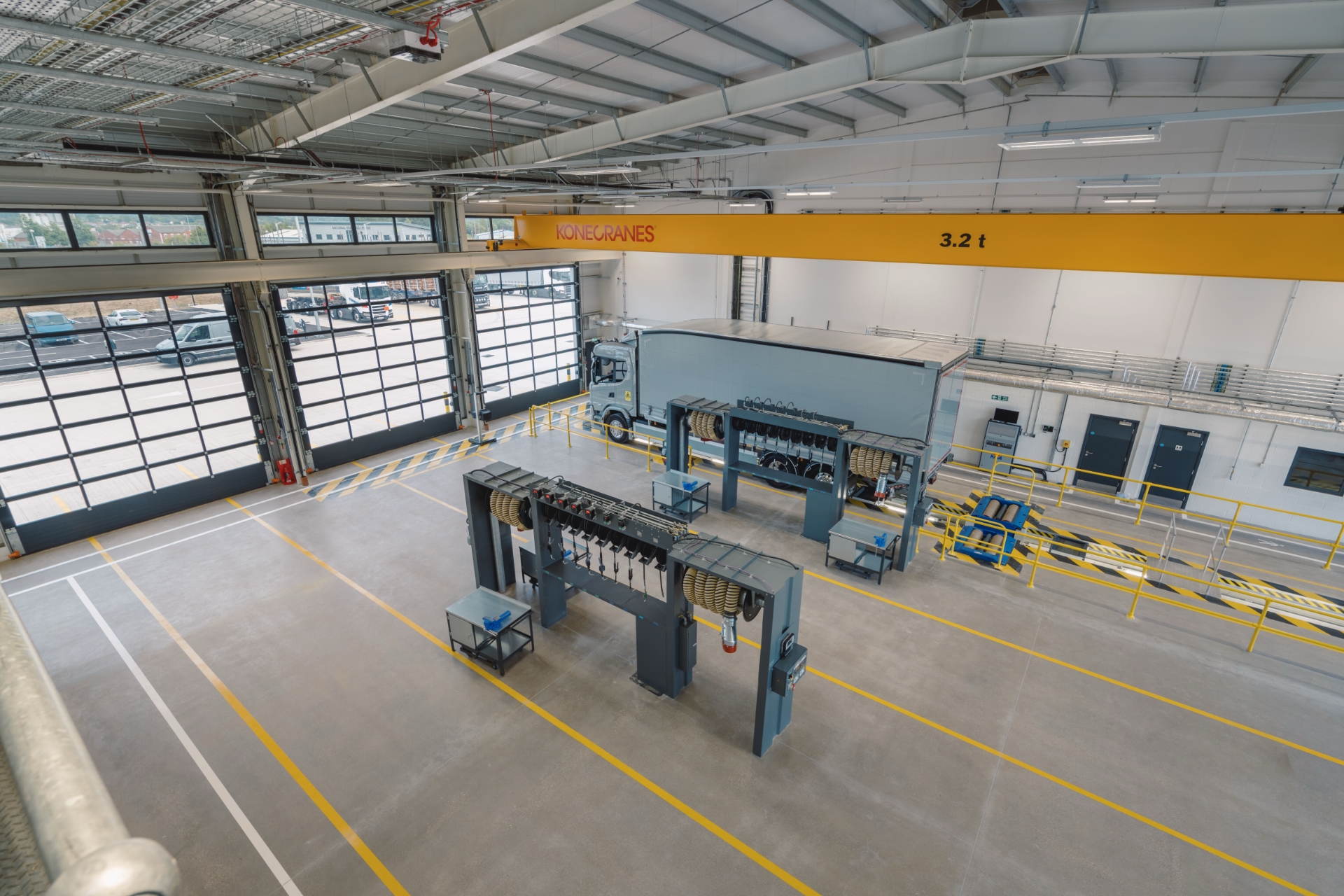
We take a look inside Scania’s future-ready Stockton Service Centre
The commercial vehicle industry is entering a period of unprecedented change. Diesel will remain the backbone of long-haul transport for years to come, but alongside it are growing numbers of gas-powered trucks and the first wave of battery-electric vehicles. For manufacturers, developing the vehicles is only half the challenge. Building a service network capable of maintaining them all is arguably the bigger task.
Scania believes the answer lies in investment, and nowhere is that more evident than at its new Stockton-on-Tees branch. Replacing the company’s Darlington operation after more than four decades of service, the new facility represents far more than a change of address. Situated in the heart of Teesside’s industrial landscape, where heavy trucks serve the region’s ports, steelworks, chemical plants and energy industries around the clock, Stockton has been designed as one of the most advanced service centres in Scania’s UK network.
The previous Darlington site had served customers well for over 40 years but was operating close to capacity. The new Stockton branch, built from the ground up, is three times larger, providing the space and facilities needed not only for today’s fleet, but also for tomorrow’s.
Advertisement
Varied support
Initially employing 34 people, with plans to increase that to around 40, the workshop has been designed to support every powertrain Scania currently offers. Whether customers operate diesel, gas or battery-electric vehicles, the aim is the same: minimise downtime while providing technicians with the tools and environment needed to work efficiently and safely.
What immediately sets Stockton apart is it has been engineered around the industry’s future, rather than adapted to it. A dedicated gas vehicle service bay has been incorporated from day one, complete with the specialist ventilation, gas detection and safety systems required to maintain compressed and liquefied gas-powered trucks safely. As more operators turn to biomethane as a lower-carbon alternative to diesel, facilities such as these are becoming an increasingly important part of Scania’s aftersales infrastructure.
Battery electric vehicles have received equal attention. Reinforced workshop floors have been installed to accommodate the additional weight of electric trucks, while overhead cranes enable technicians to remove and refit major battery components safely. Outside, a dedicated truck charger supports vehicle servicing, while multiple three-phase electrical connections throughout the workshop allow mobile charging equipment to be used wherever required.
Importantly, the site’s electrical infrastructure has been future-proofed, with sufficient grid capacity already in place to accommodate additional high-powered truck chargers as electric fleets expand.
Safety first
Unsurprisingly, safety has been a major consideration. High-voltage vehicles demand procedures that differ significantly from conventional trucks, and Stockton has been equipped with the latest EV safety systems, including lock-out and tag-out equipment that ensures vehicles can be electrically isolated before technicians begin work.
Yet the new building is only one part of Scania’s strategy. Stockton is the latest addition to a wider programme of investment across the Scania Great Britain dealer network, following similar developments at Eurocentral, Falkirk and Bury St Edmunds, with further sites already in the pipeline alongside the company’s franchise partners.
Behind these investments lies a clear objective: ensuring Scania’s nationwide service network evolves at the same pace as its products.
Although battery-electric truck numbers remain relatively modest today, Scania already has dedicated BEV service capability across every UK region, strategically positioned close to major operators that have begun introducing electric vehicles into their fleets. Over time, however, the ambition is far greater. Every one of Scania’s 80-plus UK workshops will ultimately be capable of servicing electric trucks.
Three-tier network
Recognising not every workshop requires the same level of capability, Scania is developing a structured three-tier network.
Category C workshops will provide routine servicing and maintenance, with the entire workforce trained in EV awareness, safe working practices and health and safety procedures around high-voltage vehicles.
Category B workshops will go a step further, employing technicians qualified to work directly on high-voltage electrical systems and undertake more specialised repairs.
Inside Scania's Stockton hub
At the top of the structure sit Category A workshops. These facilities will house Scania’s most highly trained EV technicians, capable of dismantling battery packs, diagnosing faults at cell level and carrying out battery module repairs that previously may have required complete unit replacement.
Supporting this rollout is an equally comprehensive training programme. Five levels of technical accreditation ensure staff develop the skills required as electric vehicles become a larger proportion of the vehicle parc. The first two levels concentrate on awareness and safe working practices for everyone in the retail network, while the higher levels provide increasingly specialist technical expertise for technicians working directly on high-voltage systems and battery diagnostics.
For operators, the significance of Stockton extends well beyond a new workshop. It demonstrates Scania’s investment is not simply about expanding capacity – it is about ensuring customers can adopt new technologies with confidence, knowing the service network is evolving alongside the vehicles themselves.
As the industry gradually transitions towards lower-carbon transport, the trucks may be changing, but one principle remains constant: uptime is everything. Facilities like Stockton are designed to ensure that, whatever powers tomorrow’s fleets, the support infrastructure is already in place to keep them moving.
The commercial vehicle industry is entering a period of unprecedented change. Diesel will remain the backbone of long-haul transport for years to come, but alongside it are growing numbers of gas-powered trucks and the first wave of battery-electric vehicles. For manufacturers, developing the vehicles is only half the challenge. Building a service network capable of maintaining them all is arguably the bigger task.
Scania believes the answer lies in investment, and nowhere is that more evident than at its new Stockton-on-Tees branch. Replacing the company’s Darlington operation after more than four decades of service, the new facility represents far more than a change of address. Situated in the heart of Teesside’s industrial landscape, where heavy trucks serve the region’s ports, steelworks, chemical plants and energy industries around the clock, Stockton has been designed as one of the most advanced service centres in Scania’s UK network.
The previous Darlington site had served customers well for over 40 years but was operating close to capacity. The new Stockton branch, built from the ground up, is three times larger, providing the space and facilities needed not only for today’s fleet, but also for tomorrow’s.
Varied support
Initially employing 34 people, with plans to increase that to around 40, the workshop has been designed to support every powertrain Scania currently offers. Whether customers operate diesel, gas or battery-electric vehicles, the aim is the same: minimise downtime while providing technicians with the tools and environment needed to work efficiently and safely.
What immediately sets Stockton apart is it has been engineered around the industry’s future, rather than adapted to it. A dedicated gas vehicle service bay has been incorporated from day one, complete with the specialist ventilation, gas detection and safety systems required to maintain compressed and liquefied gas-powered trucks safely. As more operators turn to biomethane as a lower-carbon alternative to diesel, facilities such as these are becoming an increasingly important part of Scania’s aftersales infrastructure.
Battery electric vehicles have received equal attention. Reinforced workshop floors have been installed to accommodate the additional weight of electric trucks, while overhead cranes enable technicians to remove and refit major battery components safely. Outside, a dedicated truck charger supports vehicle servicing, while multiple three-phase electrical connections throughout the workshop allow mobile charging equipment to be used wherever required.
Importantly, the site’s electrical infrastructure has been future-proofed, with sufficient grid capacity already in place to accommodate additional high-powered truck chargers as electric fleets expand.
Safety first
Unsurprisingly, safety has been a major consideration. High-voltage vehicles demand procedures that differ significantly from conventional trucks, and Stockton has been equipped with the latest EV safety systems, including lock-out and tag-out equipment that ensures vehicles can be electrically isolated before technicians begin work.
Yet the new building is only one part of Scania’s strategy. Stockton is the latest addition to a wider programme of investment across the Scania Great Britain dealer network, following similar developments at Eurocentral, Falkirk and Bury St Edmunds, with further sites already in the pipeline alongside the company’s franchise partners.
Behind these investments lies a clear objective: ensuring Scania’s nationwide service network evolves at the same pace as its products.
Although battery-electric truck numbers remain relatively modest today, Scania already has dedicated BEV service capability across every UK region, strategically positioned close to major operators that have begun introducing electric vehicles into their fleets. Over time, however, the ambition is far greater. Every one of Scania’s 80-plus UK workshops will ultimately be capable of servicing electric trucks.
Three-tier network
Recognising not every workshop requires the same level of capability, Scania is developing a structured three-tier network.
Category C workshops will provide routine servicing and maintenance, with the entire workforce trained in EV awareness, safe working practices and health and safety procedures around high-voltage vehicles.
Category B workshops will go a step further, employing technicians qualified to work directly on high-voltage electrical systems and undertake more specialised repairs.
Inside Scania's Stockton Service Centre
At the top of the structure sit Category A workshops. These facilities will house Scania’s most highly trained EV technicians, capable of dismantling battery packs, diagnosing faults at cell level and carrying out battery module repairs that previously may have required complete unit replacement.
Supporting this rollout is an equally comprehensive training programme. Five levels of technical accreditation ensure staff develop the skills required as electric vehicles become a larger proportion of the vehicle parc. The first two levels concentrate on awareness and safe working practices for everyone in the retail network, while the higher levels provide increasingly specialist technical expertise for technicians working directly on high-voltage systems and battery diagnostics.
For operators, the significance of Stockton extends well beyond a new workshop. It demonstrates Scania’s investment is not simply about expanding capacity – it is about ensuring customers can adopt new technologies with confidence, knowing the service network is evolving alongside the vehicles themselves.
As the industry gradually transitions towards lower-carbon transport, the trucks may be changing, but one principle remains constant: uptime is everything. Facilities like Stockton are designed to ensure that, whatever powers tomorrow’s fleets, the support infrastructure is already in place to keep them moving.