Founded in 2008, Norwich-based Shred Station has grown rapidly across the last two decades. From a single mobile shredding truck operating locally around East Anglia, it has expanded into not just one of the biggest names in the UK’s data destruction sector, but also the world’s largest independently owned shredding company.
Unsurprisingly, the business’ fleet has had to grow too. Today, Shred Station runs a 100-strong commercial vehicle operation which works across the length and breadth of the UK, underlining the company’s rapid progress. However, just like many other operators, it is bracing itself for the next transition – the move towards alternatively fuelled vehicles.
“We are always looking for ways to reduce our emissions,” explains Simon Franklin, Shred Station’s founder and managing director.
“Sustainability and reducing our environmental impact are core to our business ethos and our fleet is our biggest source of carbon emissions, contributing as much as 80% of our total output. Having closely tracked our annual carbon and greenhouse gas output, we have already started to adopt smaller electric powered machinery such as forklifts, to eke out some key gains. However, there is certainly more to be done in the next few years.”
That drive has pushed the business towards trialling larger electric vehicles, and while several different models have been tested within Shred Station’s operations, it only recently found an electric truck that delivered both the emissions savings and functional performance it needs.
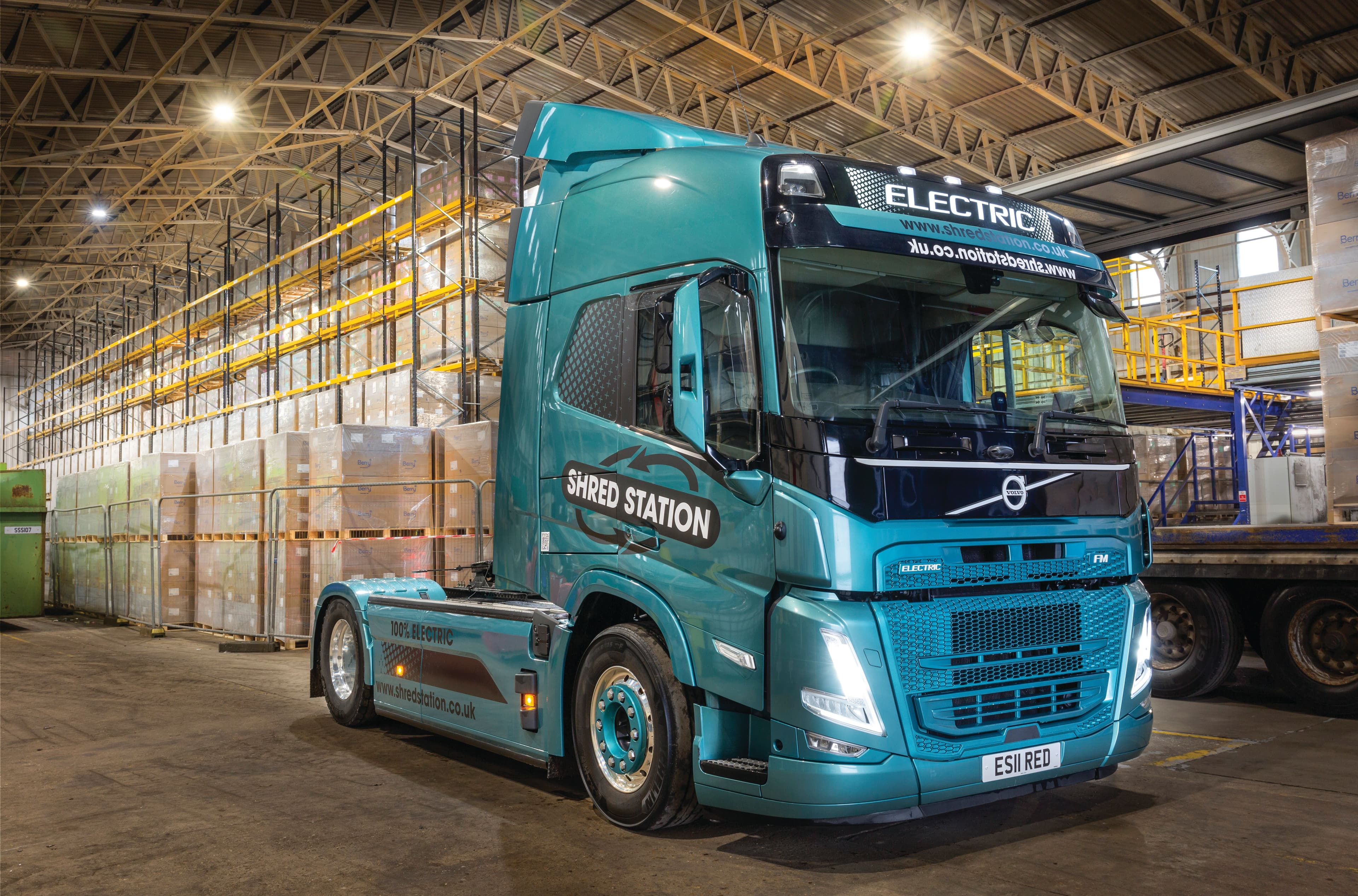
“After a few different trials we have settled on a Volvo FM Electric,” explains Franklin. “We had been exploring zero tailpipe-emission vehicles for a long time, testing different models with varying degrees of success. Some did not have the right range, others could not handle the required load capacity, some were just not commercially viable, and some failed on all three counts. The Volvo though has finally met our needs. It delivers the right balance of range, charging capability, and operational efficiency, making it a viable solution for integrating electric vehicles of this size into our fleet.”
Shred Station’s FM Electric – supplied by Karl Love, Sales Executive, Volvo Trucks – faces a busy workload. Paired with a double-deck trailer, the tractor unit is on the road five days a week, with its efforts dedicated to handling local contracts in East Anglia, including transporting paper destined for recycling mills. The FM has more than enough range for this localised workload, with the truck comfortably capable of transporting 50 pallets at a go.
“One of the biggest challenges with electric vehicles is the range, but that is not an issue for our FM Electric because we have strategically assigned it to routes that keep it within a manageable radius of our main depot,” says Franklin. “That way, it can operate efficiently throughout the day and return to base for charging as needed. This style of deployment has allowed us to replace a diesel truck without any compromise or disruption to our existing workflow, making it an effective step forward in reducing our carbon footprint while maintaining the reliability of our services.”
The truck has also made a strong impression on Shred Station’s chosen driver, the highly experienced Jim Kerr. Previously, he was paired with one of Shred Station’s diesel Volvo FHs and despite him holding a fondness for the legacy technology, his new electric truck has made quite an impact.
“One of the first things you notice is how quickly the truck moves off – it is smooth and responsive in a way that feels completely different from a traditional diesel vehicle,” reports Kerr. “You get the power and precision right when you need it, which is not always the case sometimes in conventional trucks. It is a more refined driving experience overall.”
This impressive performance is delivered by the truck’s three electrical motors, which can generate a total up to the equivalent of 666 hp, and 2,400 Nm of continuous torque. In addition, the FM Electric’s electromobility traction control system helps to manage power output on slippery surfaces, while different drive modes are available to set the desired performance, comfort, and energy usage levels. Just as with Volvo’s existing diesel range, the vehicle also uses the standard I-Shift gearbox to guarantee a smooth and ultra-quiet in-cab driving experience.
Shred Station’s new truck also features Volvo Dynamic Steering, the manufacturer’s ultra-responsive system designed to lessen driver steering force by up to 85%. The technology increases road safety and reduces driver fatigue by combining conventional hydraulic power steering with an electric motor fitted to the steering gear, offering perfect stability and control at all speeds.
The new arrival is decked out with a top-of-the-range Drive++ interior package. This adds dual armrests, leather upholstery and fully electronic air conditioning with sun, mist, air quality sensors and a carbon filter, all fitted to a spacious Globetrotter cab.
“The quietness of the truck really stands out, as does the in-cab experience,” says Kerr. “In a diesel vehicle, you do not always realise how much of an impact the noise and vibrations have on your day until they are gone. With the FM Electric, the silence and smooth ride makes the entire experience so much more pleasant.”
Shred Station also reports some practical benefits of switching out a diesel model for an electric equivalent. For instance, the company is saving time by cutting out the need to refuel before the truck can leave for its day’s work.
“Jim no longer has to stop at fuel stations or wait around while the truck refuels. Instead, it is simply plugged in at the depot and it is ready to go the next morning,” adds Franklin.
While it is early days for Shred Station operating an electric vehicle of this size, its team is highly optimistic not just for its first FM Electric, but to also continue accelerating its broader decarbonisation plans. The business is already a lifetime CarbonNeutral certified company and is aiming to be Net Zero by 2030, but, as Franklin adds, it is always looking for ways to further reduce its carbon footprint.
“Finding a suitable electric truck has been on our radar for a long while now, especially given that our fleet is our largest emission source,” he adds. “Of course, not all of our routes are suitable – at least not today – for a switch to electric trucking, but that certainly does not mean that this FM Electric is the be-all and end-all for us on this front.
“Just look at how electric vehicle technology has advanced in the passenger car sector over the last decade or so. We anticipate that future truck models will offer significantly greater ranges much like the way electric cars have evolved. Once those improvements materialise, we will have even more opportunities to expand our electric fleet and integrate these vehicles into longer routes.”
Even so, today the hope is that the FM Electric’s arrival will make a sizeable dent in Shred Station’s emissions output.
“When we switched our forklifts to electric, we immediately eliminated 10,400 litres of diesel consumption per forklift each year. The impact of electrifying a tractor unit is going to be even more significant given how much fuel they consume by comparison,” concludes Franklin. “By taking one diesel artic off the road and replacing it with an electric one, we’re making meaningful progress towards reducing our carbon footprint.
“We know we cannot eliminate emissions, but every step we take toward electrification moves us closer to our goal.”