Share this post
Viritech and Haydale to extend cooperation in hydrogen pressure vessels

Viritech and Haydale to extend cooperation in hydrogen pressure vessels

Published on 21 Mar 2023 • 3 min read

Viritech extends partnership with Haydale to develop graphene-enhanced hydrogen pressure vessels, focusing on lightweight, efficient storage for fuel cell vehicles.

Viritech, the leading developer of high-performance hydrogen powertrain solutions for the automotive industry has announced that it is extending its cooperation with Haydale, a global technology solutions company and a leader in functionalised graphene-enhanced nanomaterials.

The two companies will work together on solutions for hydrogen pressure vessels for the automotive industry, initially focusing on commercial vehicles.

This cooperation is timely, as the UK’s Advanced Propulsion Centre (APC) has recently published a report which highlights that by 2030, fuel cell electric vans will offer a lower total cost of ownership (TCO) than battery-electric vans, for applications where the vehicle travels more than 300 miles per day - vans on more than one shift a day would be a prime example.

In focussing on Type V, linerless pressure vessels, Viritech and Haydale are looking to develop the world’s most efficient vehicle storage system for gaseous hydrogen. This technology will have wide application, including to the automotive, aerospace, and marine industries, with immediate application in the emerging market for fuel cell vans.

The project will entail the development of new functionalised materials and resins for Type V pressure vessels, delivering considerable weight savings and removing the need for an inner liner, which is currently required in composite pressure vessels to act as an impermeable barrier. Instead, Viritech and Haydale’s advanced graphene-enhanced carbon fibre material, will enable the construction of impermeable pressure vessels.

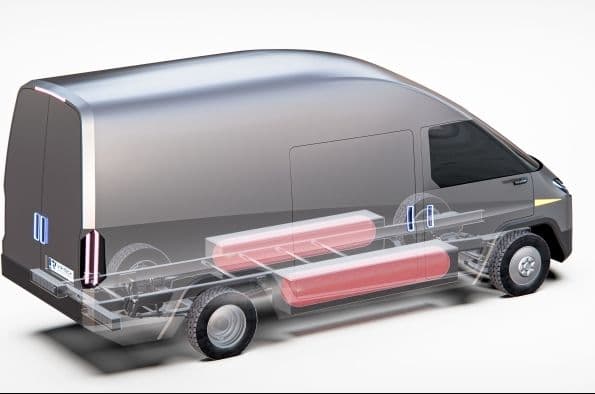
In addition, Viritech will be further developing its Graph-ProTM structural pressure vessels, which include fixing points which attach directly to a vehicle chassis, meaning no separate attachments or frames are required. This greatly simplifies the installation of pressure vessels and saves considerable weight.

Having previously co-developed hydrogen storage solutions for Viritech’s iconic Apricale Hypercar, this collaboration marks the next stage in the Viritech-Haydale partnership and will play a significant role in bringing UK developed and industry-leading storage solutions to the automotive market.

Timothy Lyons, CEO of Viritech said,

We are delighted to be extending our partnership with Haydale. With hydrogen’s growing emergence as a key pilar in the road to ‘Sustainable Transportation’ vehicle manufacturers are starting to design their first series-production fuel cell vehicles, and working together, our two companies are ideally placed to capitalise on one of the most important growth markets of the next two decades.

Keith Broadbent, CEO of Haydale said,

We are pleased to be continuing our work with Viritech, and, together, be leading the way with ground-breaking hydrogen pressure vessel designs. Our expertise in functionalised nano materials alongside Viritech’s pioneering approach to fuel cell vehicles is an exciting step forward in providing the technology for this growing market.
More news

Chery UK to launch four new and updated models in the next 12 months to drive strategic growth
12 September 2026

Chery UK to launch four new and updated models in the next 12 months to drive strategic growth

Chery UK will launch four new and refreshed models over the next 12 months, including its first electric vehicle, as it builds on a strong first year in the UK market.

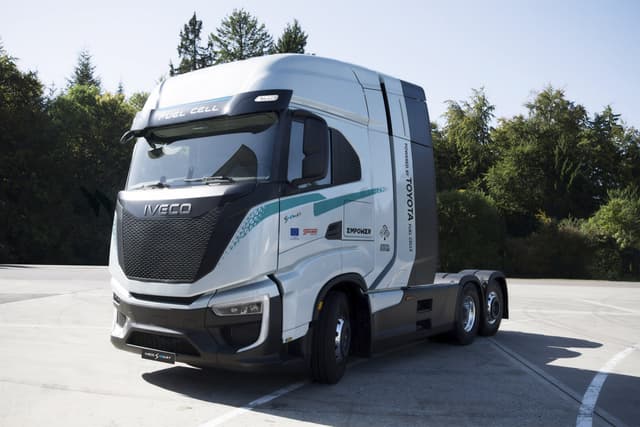
IVECO and Toyota join forces to advance next-generation hydrogen fuel cell heavy-duty trucks through the EU-funded EMPOWER project
10 September 2026

IVECO and Toyota join forces to advance next-generation hydrogen fuel cell heavy-duty trucks through the EU-funded EMPOWER project

IVECO and Toyota partner under the EU-funded EMPOWER project to develop next-generation hydrogen fuel cell heavy-duty trucks, targeting more than 900 km of range and 25,000 operating hours.

Under £20k: Harris MAXUS UK takes on compact electric van market with eDELIVER 3
7 September 2026

Under £20k: Harris MAXUS UK takes on compact electric van market with eDELIVER 3

Harris MAXUS UK launches a new sub-£20,000 acquisition proposition for its compact electric eDELIVER 3 van.

SINOTRUK targets UK zero-emission truck market with Harris Group deal
4 September 2026

SINOTRUK targets UK zero-emission truck market with Harris Group deal

Harris Group has signed a long-term deal to become SINOTRUK's exclusive UK and Ireland distributor, bringing a new range of battery-electric trucks to market from 2027.

Finding the Right Route to Zero: Matching Electric Trucks to Real-World Operations
1 September 2026

Finding the Right Route to Zero: Matching Electric Trucks to Real-World Operations

Mercedes-Benz Trucks' eActros 400 and eActros 600 share a common electric architecture but target very different duty cycles — showing there is no single route to net zero for fleet operators.

Warrington biomethane station to expand Gasrec's growing network
25 August 2026

Warrington biomethane station to expand Gasrec's growing network

Gasrec has secured planning permission for its first large-scale, public-access Bio-LNG station in the North West – a Warrington facility capable of refuelling 1,000 gas trucks a day.

Warburtons takes delivery of first Yutong TE7 7.5t electric truck
20 August 2026

Warburtons takes delivery of first Yutong TE7 7.5t electric truck

Warburtons has taken delivery of its first Yutong TE7 7.5t electric truck from Pelican Electric Trucks, the first of seven ordered as it works to electrify its 170-strong fleet of 7.5-tonne vehicles.

Conservatives pledge to repeal diesel HGV phase-out and scrap zero-emission truck grants
20 August 2026

Conservatives pledge to repeal diesel HGV phase-out and scrap zero-emission truck grants

The Conservatives have announced plans to repeal Labour's 2035 and 2040 diesel HGV phase-out dates, abolish the Zero Emission Van and Truck Grants, and rule out new mandates — backing a technology-neutral, multi-fuel approach to cutting freight emissions.