A practical alternative to diesel
Diesel is no longer the only realistic answer for long-haul transport. While battery-electric trucks attract much of the industry attention, compressed natural gas — particularly when fuelled by biomethane — is emerging as a serious low-carbon solution for operators who need cleaner transport without sacrificing range, payload capability or operational flexibility.
For many fleets, CNG offers something increasingly valuable: a transition technology that already works in real-world haulage.
Turning waste into transport fuel
Biomethane is produced through anaerobic digestion, where organic waste such as food waste, livestock manure, sewage sludge and brewery by-products are broken down in oxygen-free conditions to create methane-rich gas.
Rather than allowing waste to decompose naturally and release methane directly into the atmosphere, the gas is captured, refined and upgraded into transport-grade fuel. The process effectively converts waste into usable energy while reducing landfill demand and agricultural emissions.
That circular energy process gives biomethane one of its strongest environmental advantages. When sourced from renewable feedstocks, biomethane can reduce CO2 emissions by around 80% compared with conventional diesel.
Where manure-based feedstocks are used, the environmental gains become even greater. Capturing methane from agricultural waste prevents a potent greenhouse gas from escaping into the atmosphere, meaning some biomethane pathways can potentially achieve net-negative lifecycle emissions.
For the freight industry, that represents a significant opportunity to reduce carbon intensity immediately rather than waiting for future technologies to mature.
Why the market is growing rapidly
The UK biomethane sector has developed rapidly over the past few years. Platts' introduction of a dedicated UK waste biomethane price index signalled that renewable gas has moved beyond niche status and into the mainstream energy market.
At the same time, local authorities across the UK continue expanding food waste collection schemes, creating larger volumes of feedstock for anaerobic digestion plants. Brewery waste, agricultural residues and commercial food processing waste are also increasingly entering the renewable gas supply chain.
As production volumes rise, operators are gaining greater confidence in long-term fuel availability and infrastructure investment.
Understanding CNG and LNG: Two methane fuels, two different approaches
Both CNG and LNG use methane as their primary fuel source, but they differ significantly in terms of storage and application.
LNG: Maximum range capability
Liquefied natural gas is cooled to approximately -160°C, reducing its volume dramatically and increasing energy density. This makes LNG highly suitable for ultra-long-distance operations where maximum range between fills is essential.
However, LNG systems are technically more complex:
-
Cryogenic storage tanks
-
Specialist refuelling procedures
-
Protective equipment requirements
-
Potential fuel boil-off losses
CNG: Simpler, more practical operation
Compressed natural gas is stored at pressures typically between 200 and 250 bar. Although less energy dense than LNG, CNG systems are mechanically simpler and easier to manage.
For many UK trunking operations, particularly depot-based fleets, CNG now offers a highly workable balance between range, operating simplicity and emissions reduction.
Scania's R460 CNG: Engineering a gas truck that feels like diesel
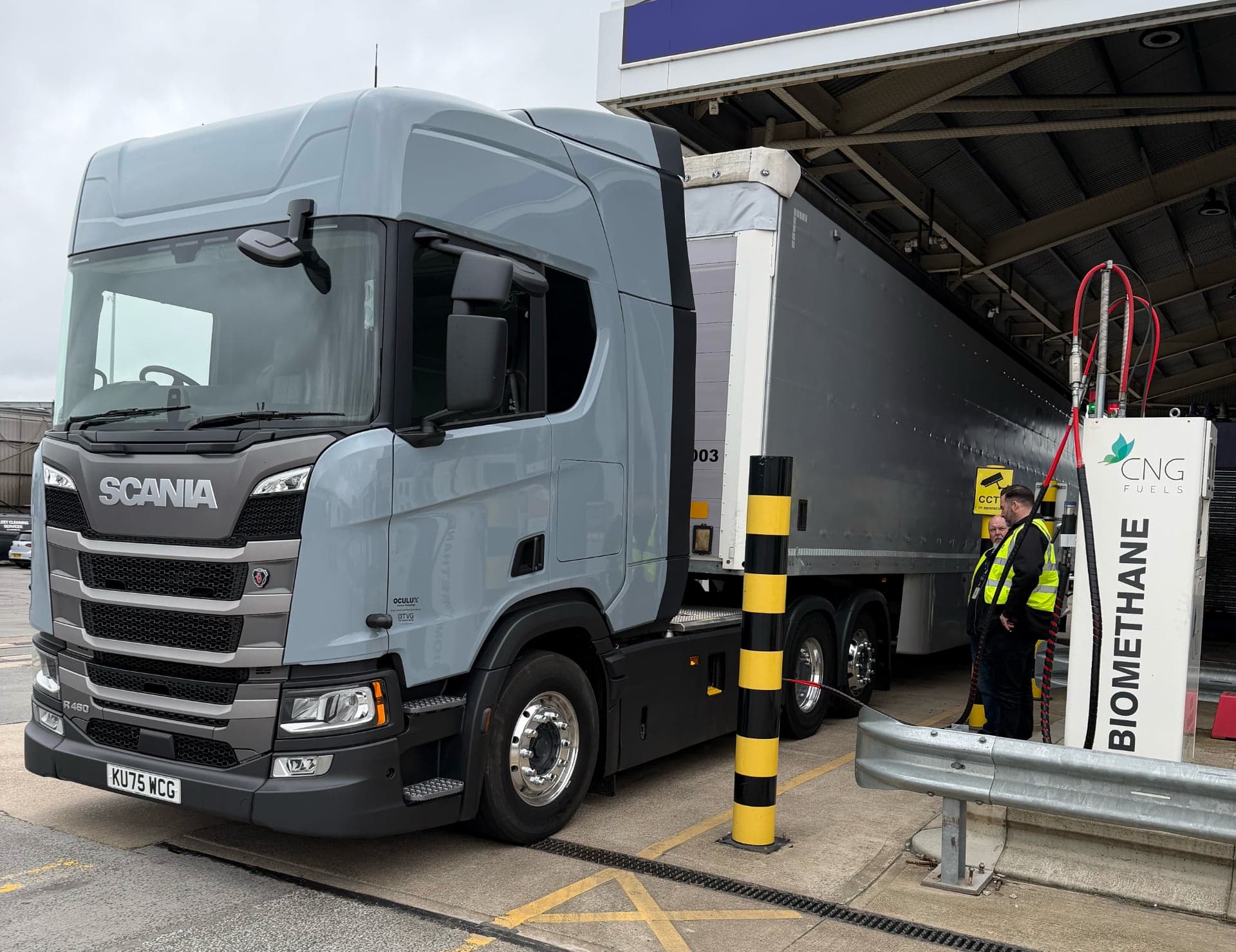
That balance is exactly what Scania has targeted with its latest R460 6x2 CNG tractor.
Power comes from the updated 13-litre OC13 spark-ignition gas engine, available in both 420hp and 460hp outputs. The flagship 460 produces:
-
2,300Nm of torque
-
Maximum torque from 1,000rpm
-
Strong low-speed pull beginning at 900rpm
-
Approximately 5% better fuel economy than the previous 410hp unit
The engineering goal was straightforward: create a gas-powered truck that behaves like a diesel.
Earlier gas engines often struggled with drivability under load, particularly at lower engine speeds. The revised OC13 addresses this through a broader torque plateau and improved calibration, allowing the truck to hold gears more effectively under heavy haulage conditions.
Paired with Scania's latest Super driveline and Opticruise transmission, the result is a remarkably familiar driving experience.
Solving the 6x2 packaging challenge: More fuel capacity without losing manoeuvrability
Designing a long-range 6x2 CNG tractor presents major engineering challenges because gas cylinders occupy considerably more space than conventional diesel tanks.
Scania's solution combines:
-
Chassis-mounted fuel cylinders
-
Additional cab-back gas storage
-
Rear-steer tag axle configuration
-
Aerodynamic front extensions permitted under revised EU length regulations
The revised arrangement increases gas storage by 144 litres over the previous design and helps deliver a claimed operating range of up to 460 miles.
The trade-off is additional vehicle weight. Compared with an equivalent diesel tractor, the CNG version carries an approximate 800kg payload penalty due largely to the fuel storage system.
For many long-haul operations, however, the compromise remains commercially acceptable given the substantial reduction in greenhouse gas emissions.
On the road at 44 tonnes: Quiet, refined and surprisingly familiar
Fully freighted at 44 tonnes, the R460 CNG immediately challenges outdated assumptions about the driving characteristics of gas-powered heavy trucks.
Pull-away performance is smooth and progressive, while the latest Opticruise gearbox responds quickly and intuitively during junction approaches and roundabout work. Earlier automated gearboxes could feel hesitant or overly reactive, but the current system delivers far more natural behaviour.
Once on the motorway, the truck settles comfortably into long-haul operation. At 56mph, the engine turns at roughly 950rpm with minimal drivetrain intrusion into the cab.
Under acceleration, the gas engine feels composed rather than strained, maintaining steady torque delivery even under heavy load. Hill-climbing performance is particularly impressive given the vehicle's weight and fuel type.
The biggest operational difference appears on downhill sections. Unlike diesel engines, spark-ignition gas engines generate less natural engine braking, meaning the hydraulic retarder plays a more important role in speed control.
Otherwise, the similarities to diesel are striking.
Back-to-back against diesel: The difference is smaller than expected
The real test came during direct comparison with Scania's diesel-powered R460 Super.
On motorway gradients and slower A-road climbs, both vehicles performed almost identically. The diesel operated at slightly lower revs and retained marginally stronger braking characteristics, but acceleration, speed recovery and gear holding were remarkably close.
In practical terms, the gas-powered tractor never felt compromised.
That matters because operators will not adopt low-carbon technology if it disrupts productivity, and drivers will not embrace vehicles that feel dramatically different from the trucks they already know.
Scania's latest CNG tractor succeeds because it demands very little adaptation from either.
The realistic route to lower-carbon freight: Why biomethane may arrive before full electrification
Battery-electric trucks will continue growing in urban and regional distribution roles, while hydrogen remains a longer-term prospect for heavy transport.
But biomethane-powered CNG already works today.
-
It supports long-range operation.
-
It refuels quickly.
-
It integrates into existing logistics patterns.
-
It delivers major emissions reductions using fuel created largely from waste streams.
For fleets seeking immediate carbon savings without sacrificing operational capability, CNG is no longer a fringe alternative. It is becoming one of the most practical and commercially viable pathways toward lower-carbon freight transport.
And in the latest generation of trucks, the most impressive thing may simply be this: from behind the wheel, it barely feels any different from diesel at all.