Share this post
Renault Trucks electrifies its Blainville - Bourg-en-Bresse - Lyon logistics corridor with Malherbe

Renault Trucks electrifies its Blainville - Bourg-en-Bresse - Lyon logistics corridor with Malherbe

Published on 16 Dec 2025 • 3 min read

Renault Trucks and Malherbe have launched a 100% electric logistics corridor between Blainville, Bourg-en-Bresse and Lyon, saving 2,869 tonnes of CO₂ annually.

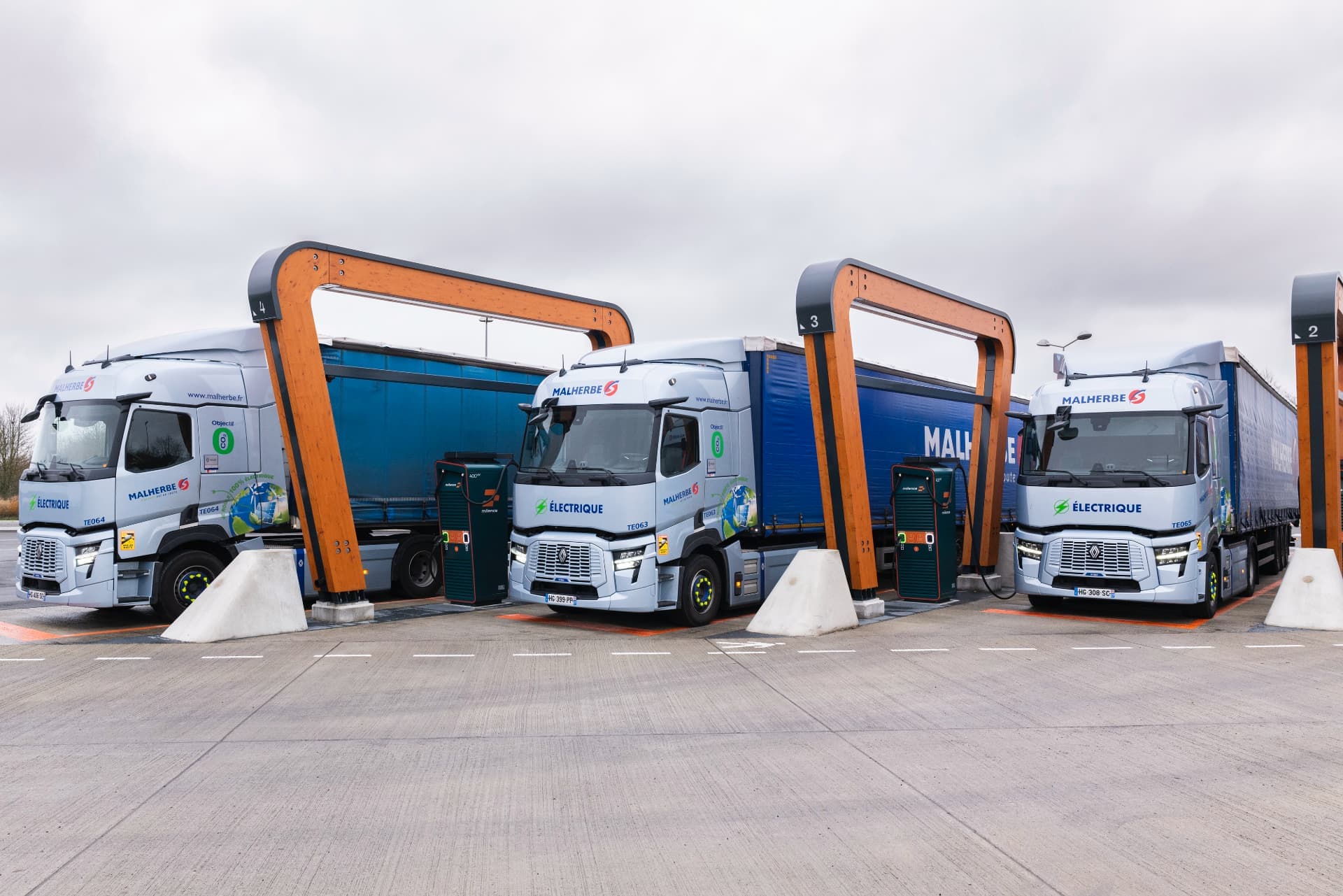
One year after decarbonising transport of axles between Lyon and Bourg-en-Bresse, Renault Trucks has taken a step further in the electrification of its internal logistics. Along with the haulier Malherbe, the manufacturer is currently deploying an electric corridor to transport cabs, engines and axles between its industrial sites.

The Renault Trucks logistics corridor linking Blainville-sur-Orne (Calvados), Bourg-en-Bresse (Ain) and Lyon (Rhône) operates on a ‘just-in-time’ basis, delivering parts to assembly lines when they are needed, without interruption:

  • Cabs in the heavy-duty range manufactured at Blainville-sur-Orne are transported to Bourg-en-Bresse to be assembled.
  • Engines and axles produced at the factories in Lyon are taken up to Blainville-sur-Orne to be integrated in trucks in the medium-duty range.

This strategic logistics flow is now covered almost entirely by 100% electric trucks.

22 Renault Trucks E-Tech T vehicles in a relay

To decarbonise transport of cabs in the heavy-duty range, and engines and axles in the medium-duty range, Renault Trucks and Malherbe are using a fleet of 22 Renault Trucks E-Tech T electric trucks:

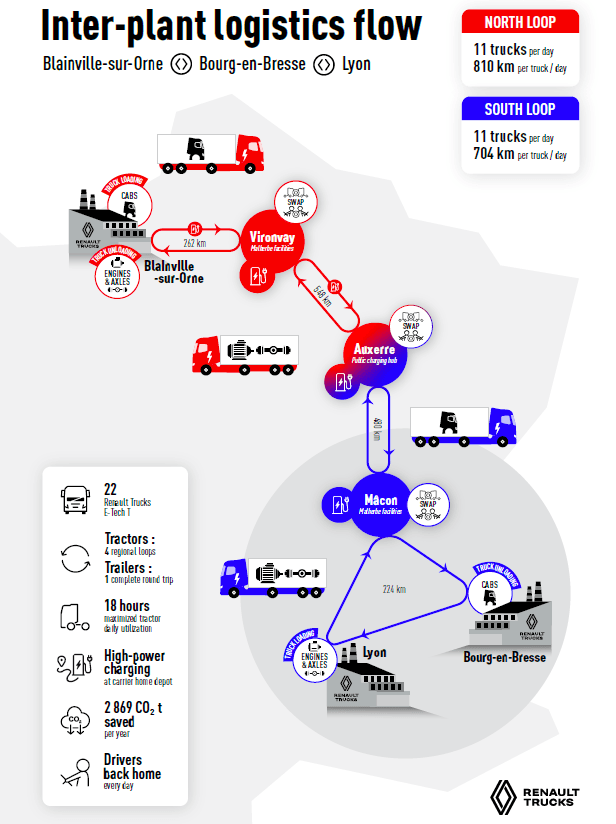
  • 11 vehicles along the North loop (Blainville – Vironvay – Auxerre – return)

  • 11 vehicles along the South loop (Auxerre – Mâcon – Bourg-en-Bresse – Lyon – return)

Thanks to a series of relay stops (to swap electric tractors, drivers and trailers), each electric truck travels a daily distance of 810 km on the North loop and 704 km on the South loop. This system makes it possible to cover long distances without stopping the load.

Fine-tuned to deliver a continuous flow

The system is based on four loops of drivers, four loops of electric tractors and one full loop for the loading (cabs for the outbound and engines-axles for the return trip):

  • The electric trucks leave the Malherbe depot at Vironvay to deliver the engines and axles from the factories in Lyon to the Renault Trucks factory at Blainville-sur-Orne.

  • They leave again loaded with truck cabs, with a changeover of electric tractors and drivers at Vironvay, Auxerre and Mâcon to maintain the flow.

  • The batteries are charged at each stage while the drivers are resting, as Malherbe has invested in installing its own charging stations at strategic points along the corridor.

  • The flow continues on to Bourg-en-Bresse and the vehicles then return to Lyon, where their trailers are loaded with engines and axles, and on it goes.
image
image

All of the stages have been designed to maximise truck usage time (up to 18 hours per day) and to keep the drivers within a close radius around their home, making the job more attractive.

By implementing a 100% electric system for this critical flow, Renault Trucks has demonstrated the reliability and maturity of its electric offer, while achieving an annual saving of 2,869 tonnes of CO₂.
More news

Chery UK to launch four new and updated models in the next 12 months to drive strategic growth
12 September 2026

Chery UK to launch four new and updated models in the next 12 months to drive strategic growth

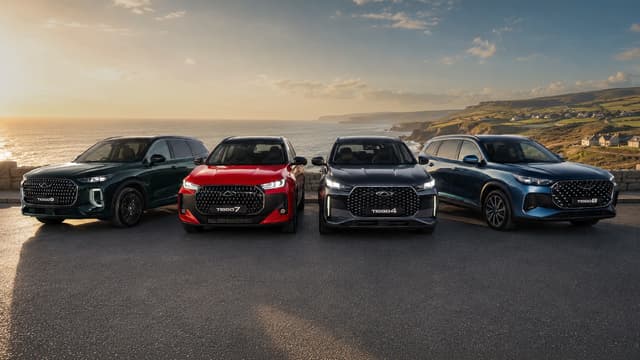
Chery UK will launch four new and refreshed models over the next 12 months, including its first electric vehicle, as it builds on a strong first year in the UK market.

IVECO and Toyota join forces to advance next-generation hydrogen fuel cell heavy-duty trucks through the EU-funded EMPOWER project
10 September 2026

IVECO and Toyota join forces to advance next-generation hydrogen fuel cell heavy-duty trucks through the EU-funded EMPOWER project

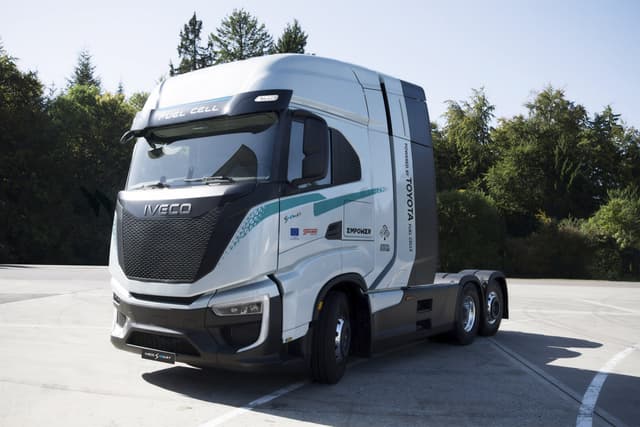
IVECO and Toyota partner under the EU-funded EMPOWER project to develop next-generation hydrogen fuel cell heavy-duty trucks, targeting more than 900 km of range and 25,000 operating hours.

Under £20k: Harris MAXUS UK takes on compact electric van market with eDELIVER 3
7 September 2026

Under £20k: Harris MAXUS UK takes on compact electric van market with eDELIVER 3

Harris MAXUS UK launches a new sub-£20,000 acquisition proposition for its compact electric eDELIVER 3 van.

SINOTRUK targets UK zero-emission truck market with Harris Group deal
4 September 2026

SINOTRUK targets UK zero-emission truck market with Harris Group deal

Harris Group has signed a long-term deal to become SINOTRUK's exclusive UK and Ireland distributor, bringing a new range of battery-electric trucks to market from 2027.

Finding the Right Route to Zero: Matching Electric Trucks to Real-World Operations
1 September 2026

Finding the Right Route to Zero: Matching Electric Trucks to Real-World Operations

Mercedes-Benz Trucks' eActros 400 and eActros 600 share a common electric architecture but target very different duty cycles — showing there is no single route to net zero for fleet operators.

Warrington biomethane station to expand Gasrec's growing network
25 August 2026

Warrington biomethane station to expand Gasrec's growing network

Gasrec has secured planning permission for its first large-scale, public-access Bio-LNG station in the North West – a Warrington facility capable of refuelling 1,000 gas trucks a day.

Warburtons takes delivery of first Yutong TE7 7.5t electric truck
20 August 2026

Warburtons takes delivery of first Yutong TE7 7.5t electric truck

Warburtons has taken delivery of its first Yutong TE7 7.5t electric truck from Pelican Electric Trucks, the first of seven ordered as it works to electrify its 170-strong fleet of 7.5-tonne vehicles.

Conservatives pledge to repeal diesel HGV phase-out and scrap zero-emission truck grants
20 August 2026

Conservatives pledge to repeal diesel HGV phase-out and scrap zero-emission truck grants

The Conservatives have announced plans to repeal Labour's 2035 and 2040 diesel HGV phase-out dates, abolish the Zero Emission Van and Truck Grants, and rule out new mandates — backing a technology-neutral, multi-fuel approach to cutting freight emissions.