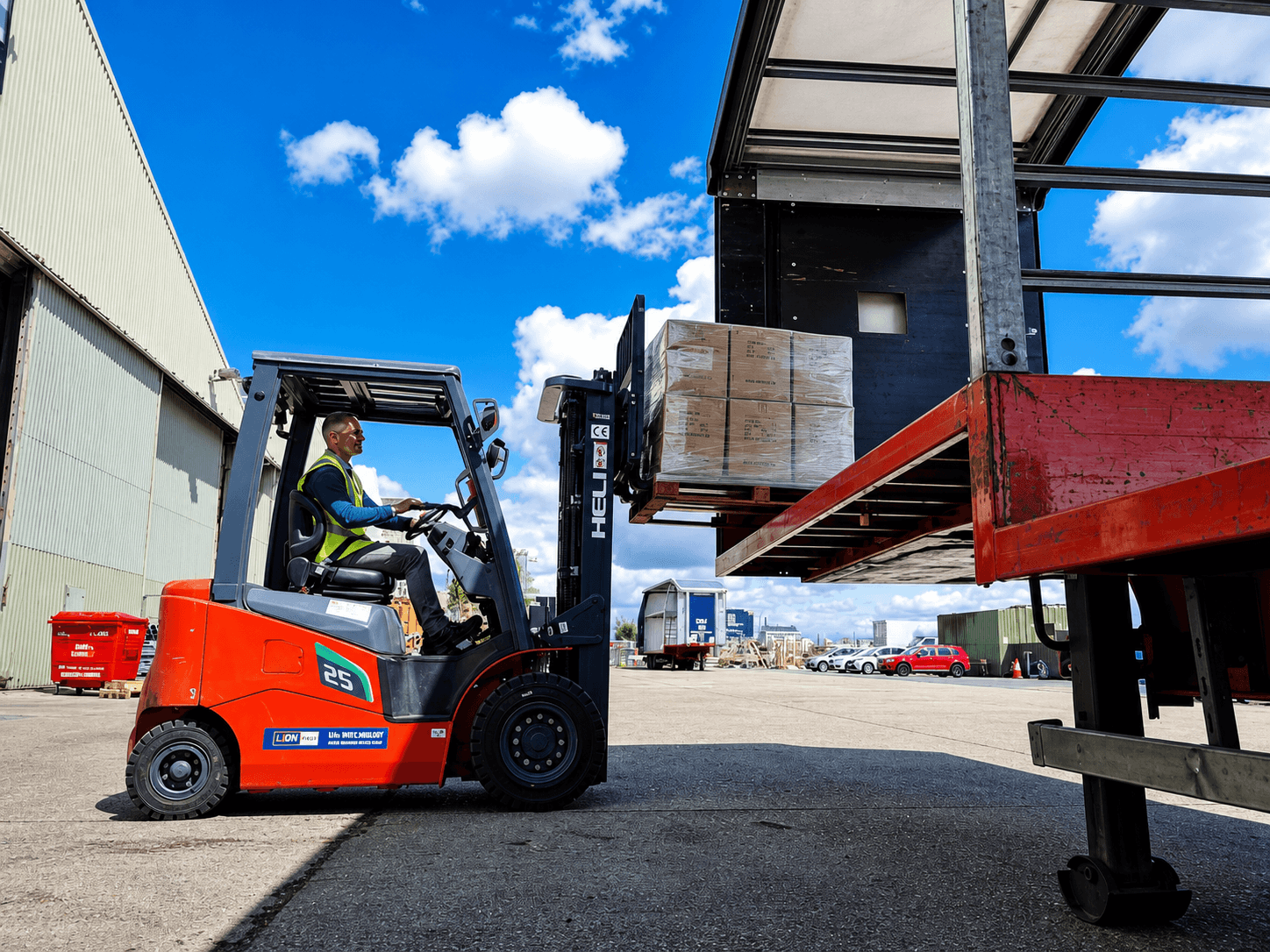
Whether it's working in a transport yard, a builders' merchant or a factory, a forklift often stays in service for years. So, when replacement time comes around, does it still make sense to buy diesel, or is lithium-ion now a better fit? Destination Net Zero spoke to Martin Walker, Head of Sales at Grant Handling, about the questions operators should ask before making that decision.
The haulage industry moves around 90% of UK freight, but trucks don't work alone. At almost every stage of the journey, forklifts are responsible for loading, unloading and moving goods safely and efficiently.
Rising energy costs, increasing pressure on productivity and growing sustainability expectations are prompting many businesses to take a closer look at their forklift fleets when replacement time arrives. What was the right solution five or ten years ago may not necessarily be the right choice today.
As businesses look to improve efficiency, reduce operating costs and support wider sustainability objectives, forklift replacement is becoming a more strategic decision. Choosing between diesel, LPG and lithium-ion is no longer simply a case of replacing like-for-like. It is about selecting the power source that best fits the way an operation works today and how it may evolve in the future.
Martin Walker, Head of Sales at Grant Handling, believes that is where many operators have the biggest opportunity.
"The first question shouldn't be 'Which forklift should I buy?' It should be 'Has my operation changed since I bought the last one?'"
Says Martin Walker:
"Businesses evolve over time. Shift patterns change, workloads increase and customer expectations move on. It's worth reviewing the operation before deciding what comes next."
With that in mind, these are the five questions Walker believes every operator should ask before investing in a new forklift.
Has my operation changed enough to justify moving from diesel to electric?
For Walker, the starting point isn't the technology, it's the application.
Diesel remains well suited to demanding outdoor environments, including builders' merchants, timber yards and heavy-duty material handling operations where uneven ground, long runtimes and high-capacity lifting are everyday requirements. LPG also continues to provide an effective solution for businesses that regularly move between indoor and outdoor environments and value fast refuelling with familiar operating practices.
Says Walker:
"People sometimes think they have to choose the newest technology. In reality, you need to choose the technology that's right for the job."
Rather than asking whether electric is better than diesel, he believes operators should first understand how, where and for how long their forklifts actually work.
When does a lithium-ion forklift make commercial sense?
One of the clearest indicators is utilisation. Operations running extended hours or multiple shifts place greater demands on equipment availability. Traditional lead-acid batteries require dedicated charging periods, whereas lithium-ion forklifts can be opportunity charged during breaks or shift changes, helping maximise uptime throughout the working day.
Maintenance also plays a part. Lithium-ion batteries require significantly less routine maintenance than traditional battery systems, reducing planned downtime and helping keep trucks in operation for longer.
Walker says these factors become increasingly important as utilisation increases.
"If a forklift is central to your operation, availability matters. Every hour it's unavailable is time when it isn't adding value to the business."
Operations such as distribution centres, transport hubs and manufacturers running double or triple shifts often see the greatest benefit from lithium-ion technology because trucks can be charged during natural breaks without disrupting operations.
Is purchase price really the best way to compare forklifts?
Not on its own. While the initial investment is always important, Walker encourages businesses to look at the bigger commercial picture.
Says Walker:
"A forklift is a long-term investment. The purchase price is only one element. You also need to think about servicing, fuel or energy costs, maintenance, downtime and how productive that truck will be over its working life."
That reflects a growing focus on total cost of ownership rather than simply acquisition cost. Charging or refuelling time, operator productivity, servicing requirements and lifetime operating costs can all influence which solution delivers the best commercial return.
In some applications, a higher upfront investment can be offset through lower energy consumption, reduced maintenance requirements and increased equipment availability over the life of the truck.
How do sustainability targets affect the business case?
For many businesses, sustainability is becoming another important factor in fleet investment decisions. Environmental targets, ESG reporting and energy management initiatives are encouraging organisations to look more closely at every aspect of their operations.
As a result, forklift fleets are increasingly being reviewed alongside wider transport and site operations as businesses seek opportunities to improve efficiency, reduce emissions and lower operating costs.
Walker believes operational performance must always come first but accepts that sustainability has become part of the wider commercial conversation.
"You still need the right truck for the application. But businesses are naturally looking at how they can improve efficiency, reduce running costs and support their wider sustainability objectives at the same time."
What's the most important question to ask before signing the order?
Walker's answer is straightforward.
"Don't assume the next forklift has to be the same as the last one."
Instead, he recommends stepping back and reviewing the operation properly. How many hours does the truck work each day? Does it operate indoors, outdoors or both? What does downtime cost the business? Is charging infrastructure practical? Does the site have sufficient electrical capacity to support future charging requirements? How might the operation change over the next three years?
Those questions may confirm that diesel remains the right solution. They may point towards LPG. Equally, they may demonstrate that lithium-ion now offers the strongest commercial case.
Either way, Walker believes the decision should be driven by operational requirements rather than habit.
"The businesses that achieve the best results are usually the ones that challenge their assumptions. When you're replacing a truck that may have been in service for ten years, it's worth checking whether today's operation still needs yesterday's solution."