

Markets are magnificent machines for pricing the next quarter and hopeless ones for pricing the next quarter-century. They will send a profitless software company to the moon while ignoring the slow-motion repricing of the single input on which every industrial civilisation has ever run: energy. So when the Financial Times published its recent opinion piece under the headline "The US needs a new Manhattan Project for fusion energy", arguing that fusion has graduated from physics experiment to strategic race and deserves wartime-scale national mobilisation, my reaction was impatience. The only question the FT leaves open is the one that should keep British boardrooms awake: if the Americans and the Chinese are treating fusion as the Manhattan Project of this century, what, precisely, is Britain's plan — and what does it mean for the industry that actually moves our economy?
Decarbonisation is simultaneously the race of our lives and the largest reallocation of capital in the history of capitalism. Fusion sits at the far end of that thesis: the highest-risk, highest-consequence bet on the board. It is the only technology that offers effectively unlimited, firm, dispatchable, carbon-free power from fuel found in seawater, with no long-lived waste and no proliferation anxiety. The physics has now been demonstrated and private capital has noticed, pouring billions into the sector at a pace that would have seemed fantastical a decade ago. What remains is engineering, supply chains and will. Which is to say: money, deployed patiently, at scale, by people who can hold their nerve for longer than one electoral cycle. History suggests this is precisely what markets and governments are worst at, and precisely what Manhattan Projects are for.
The forty-tonne problem
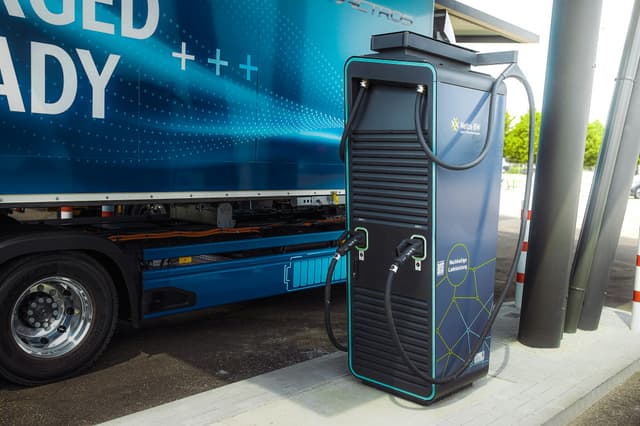
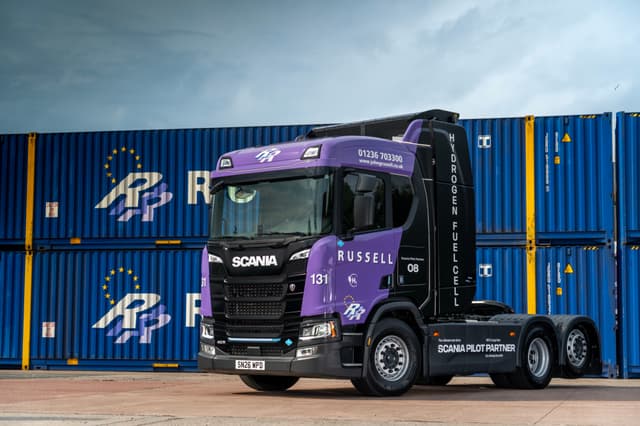
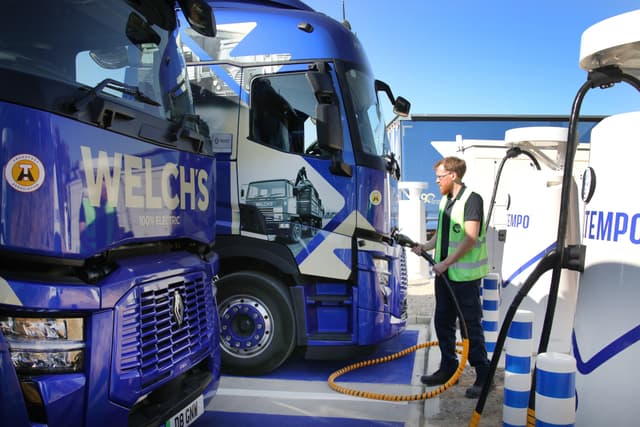
Now, to the unglamorous bit. Road haulage is the circulatory system of the British economy — nearly everything you own, eat or wear spent time in the back of a truck — and it is stubbornly, structurally hard to decarbonise. Heavy goods vehicles are a small minority of the vehicles on our roads yet contribute roughly a fifth of domestic transport emissions, and transport remains the largest-emitting sector in the country. The reason is not moral failure among hauliers, an industry that runs on margins thinner than the paint on its trailers. The reason is physics and arithmetic. A forty-four-tonne artic doing intensive motorway work needs energy density, rapid turnaround and total reliability. Batteries are winning the urban and regional duty cycles faster than the sceptics predicted, but every tonne of battery is a tonne of payload forgone, and a depot of electric HGVs demands grid connections measured in megawatts — connections for which operators are currently quoted waiting times that would embarrass a Soviet tractor factory. Hydrogen solves the weight problem, but critics cite an efficiency problem.
Here is the insight that the net-zero debate keeps missing, and where the FT's fusion argument lands squarely on the haulier's desk: batteries, hydrogen and synthetic fuels are not three competing technologies. They are three different containers for the same commodity — clean electricity. Every credible pathway to a zero-carbon truck fleet is, at bottom, a bet on the price of the clean electron. At the prices fusion could eventually deliver — abundant, firm power, sited where you need it, running at capacity factors renewables can only dream of on a windless January night — the entire cost stack inverts. Megawatt charging hubs become bankable. Electrolytic hydrogen becomes a fuel rather than a subsidy. Even synthetic diesel for the legacy fleet stops being a fantasy. Cheap clean energy does not merely decarbonise haulage; it dissolves the trade-offs that currently paralyse it.
In investing, the cost of being early is measured in basis points. In energy, the cost of being late is measured in industries — and occasionally in civilisations.
Britain's awkward genius
The bitter comedy is that Britain is genuinely good at this. Culham held the world record for fusion energy. The government's STEP programme aims to put a prototype fusion plant on the old coal site at West Burton around 2040 — a poetic bit of industrial succession, coal to starfire on the same grid connection. Privately funded pioneers in Oxfordshire are building spherical tokamaks and projectile-fusion machines that attract global capital. And yet the national pattern is depressingly familiar: we invent, we underfund, we hesitate, and we then buy the commercialised product back from whichever nation had the nerve to industrialise it. The FT is right that the United States needs a Manhattan Project for fusion. Perhaps Britain needs, at minimum, a Bletchley Park: focused, funded, unapologetically strategic — and connected, from day one, to the industries that will consume the output. Freight should be first in that queue, because freight is where cheap firm power converts most directly into competitiveness, food prices and the cost of living.
What would that look like in practice? It looks like planning fusion — and, in the interim, new fission — alongside the freight map rather than apart from it: firm clean power feeding megawatt charging and hydrogen production at the ports, the motorway corridors and the great distribution parks of the Midlands and the North — Andy Burnham might want to take credit within Manchesterism. It looks like grid reform that treats a haulage depot's connection request as strategic infrastructure rather than a nuisance. And it looks like patient capital — pension funds, insurers, sovereign investors — being invited into energy-for-freight infrastructure with the long, dull, index-linked returns they claim to crave. None of this requires fusion to arrive tomorrow. It requires us to make decisions today that are not embarrassed by fusion when it arrives.
The long game, played properly
Investors mistake the improbable for the impossible and the distant for the irrelevant. Fusion in the 2040s sounds distant until you remember that a truck financed today will still be working in 2035, that a depot built today will operate into the 2060s, and that an operator licence, well run, outlives us all. The haulage industry's race to net zero will not be won by whichever operator buys the first electric tractor unit for the photograph. It will be won by those who understand that they are, whether they like it or not, energy businesses now — and who position themselves for a world in which the clean electron becomes cheap, abundant and British. The FT has called for a Manhattan Project across the Atlantic. The correct response on this side of it is not to spectate. It is to compete. In the race of our lives, the trucks, as ever, will carry the load.
Source: "The US needs a new Manhattan Project for fusion energy", Financial Times (Opinion), ft.com.