HVS (Hydrogen Vehicle Systems), an innovator in zero-emission commercial vehicles, has unveiled a five-point plan outlining the key steps required to realise the widespread adoption of hydrogen-powered HGVs and a call to action to drive the transition to a hydrogen economy.
HVS (Hydrogen Vehicle Systems), an innovator in zero-emission commercial vehicles, has unveiled a five-point plan outlining the key steps required to realise the widespread adoption of hydrogen-powered HGVs and a call to action to drive the transition to a hydrogen economy.
HVS has identified and is calling for clarity on detailed timescales, supported by policy incentives to encourage early adoption of vehicles. This includes changes to legislation, green hydrogen production subsidies and commitments to infrastructure development, as well as support for workforce training.
HVS’ roadmap aims to propel the industry forward, enabling more rapid decarbonisation of the goods delivery sector, and helping the UK to meet its commitment to achieving net-zero targets.
Jawad Khursheed, CEO of HVS commented:
HVS' hydrogen technology holds a major key in supporting governmental emissions reduction targets, both here in the UK and in Europe, through the decarbonisation of the heavy goods sector. However, change in this market is not happening quickly enough – which is why, today, we are unveiling this five-point plan, outlining a roadmap that will accelerate the transition to hydrogen HGV fleets.
This industry desperately needs clarity from the UK government on incentives to encourage the early adoption of hydrogen HGVs, alongside commitments to support the development of new H2 technology, green hydrogen infrastructure and revisions to regulations.
HGVs are the second largest contributors to UK transport emissions. Whilst they make up just 1.5% of all vehicles on our roads, they contribute a disproportionate 19% of all vehicle emissions. With their numbers increasing, their emissions are likely to increase. Our roadmap shows how the haulage industry can seamlessly move from fossil-fuelled fleets to green hydrogen HGVs, enabling the UK to remain competitive globally and ensuring climate change goals are met.
1. Incentives
Governments must implement a package of support measures that provide operators with incentives and offer clarity on actual costs to generate confidence to invest in new fleets. Providing incentives, such as financial support and emissions-based vehicle purchasing, would strengthen the economic case to drive faster uptake thus bridging the gap between diesel and hydrogen-powered vehicles.
HVS has already proposed a ‘pay-as-you-pollute’ initiative by replacing fuel duty with a carbon emissions related price. This approach would ensure a more equitable distribution of environmental and social costs of burning fossil fuels, compared to clean low carbon, sustainable alternatives.
The industry is very close to achieving cost parity with diesel and a relatively small package of measures will be sufficient to reduce uncertainty and drive the necessary transition.
2. Legislation and regulatory framework changes
The reliance on diesel-powered HGVs, which account for 96% of the fleet currently in operation, means there is pressing urgency for change. If there is no pathway to transition provided now, we risk locking-in carbon emissions of new diesel vehicles, which will operate for the next 10 years.
To prevent this, governments and local authorities must provide clear commitments to supporting the transition by setting ambitious carbon reduction targets and adopting sector-specific goals.
Across the UK and Europe, governments could look to enact increasing the 2030 CO2 emissions cut target from 45% to 65% and establish definitive phase-out dates for internal combustion engine heavy trucks. By setting a reasonable timeline and sticking to it would give the industry time to plan for the transition, and provide manufacturers, fleet operators, and other stakeholders clarity, assurance, and direction in how to act and invest. However, targets without supporting policy measures are insufficient.
There is a further measure that needs to be urgently addressed: the regulations surrounding the transportation of hydrogen. These were defined for smaller market volumes and shorter delivery distances. However, with the emergence of new materials that allow for increased capacities and improved payload capabilities of hydrogen trailers, as well as the need to facilitate hydrogen delivery at larger scales, it is imperative to revise and adapt these existing standards accordingly. At present, it is not possible to haul a hydrogen tube trailer containing bulk hydrogen with anything other than a diesel tractor unit. An absurd position as the early adopters will most definitely include the hydrogen infrastructure providers.
3. Green hydrogen production
The UK has made commendable progress in decarbonising its electricity industry, but to maintain momentum and be a potential world leader, it must take advantage of further renewable resources.
HVS calls on the UK Government to ramp up support for the increased production of renewable energy and channel these efforts into green hydrogen production. This will enable infrastructure investors to scale up, driving down hydrogen costs which in turn reduce the TCO for hydrogen-powered HGVs. As the rollout of H2 infrastructure continues and demand increases, the price of sustainable renewable hydrogen is expected to reach and then be below parity with diesel, further driving its adoption.
Tax and support regimes also play a vital role, as even a slight shift in the relative price of renewable hydrogen compared to diesel could realise high-load, high-mileage HGVs transition earlier, resulting in significant carbon emission reductions by eliminating the worst polluting vehicles.
HVS and its strategic investor, Euro Garages (EG) Group, are working closely to ensure a reliable supply of green H2. It is crucial for confidence that government provide for full and transparent certification of the fuel source to the needs of early adopters who prioritise low-carbon and sustainable transport and provide for a method to monetise the carbon credit for displacement of diesel.
4. Infrastructure
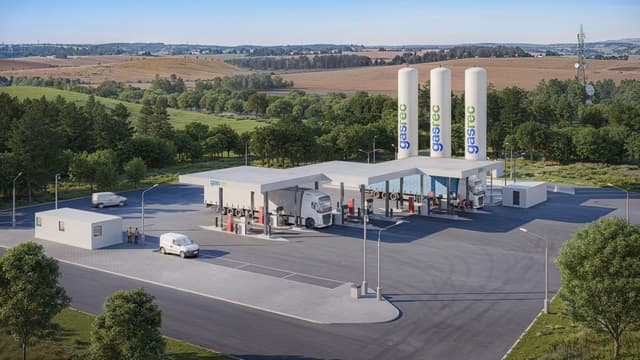
There is a current lack of third-party supplied infrastructure for both electric and hydrogen vehicles. HVS has undertaken a heat map analysis of the UK logistics road network and estimates that as little as seven strategically located hydrogen refuelling stations would be required to serve most HGV movements in the motorway distribution network. Initially, these refuelling stations could be mobile, catering to small or regional deployments, and then later transition to fixed structures to accommodate growing demand.
The scalable rollout of hydrogen refilling stations also provides a solution for other potential users, including cars and vans. HVS collaborates closely with its strategic investor, Euro Garages (EG) Group, which already has a significant network of existing refuelling forecourts. By focussing first on long-haul HGVs joining together regional hubs and the collaboration with a station operator completely solves the chicken-and-egg situation of hydrogen deployment for vehicles and ultimately other uses.
5. STEM skilled workforce and training
To support the transition, HVS recognises the importance of a skilled workforce. Investment in STEM (Science, Technology, Engineering, and Mathematics) cultivates and promotes R&D initiatives, and provides opportunities for collaboration between academia, industry, and government.
STEM experts offer invaluable support with expertise spanning across R&D, engineering, design, and production – all elements that contribute to innovation, economic development, and a more secure future for hydrogen.
Training and education programs are essential to establish a capable workforce at both the original equipment manufacturer (OEM) and tier 1 supplier levels. These programs focus on building the expertise needed to manufacture and maintain fleets of commercial hydrogen-electric vehicles. STEM education and specialised training will help professionals play a significant role in educating and training the future workforce in the hydrogen transportation industry.
HVS, through the pioneering development of its ground-breaking hydrogen HGV is driving the hydrogen transition and will deliver a greener future for the heavy goods vehicle industry. The proposals and call for support of this five-point plan aim to accelerate the adoption of hydrogen HGVs, provide solutions to the climate challenges we face, and ultimately create a truly sustainable transportation sector.